

 Copy to clipboard
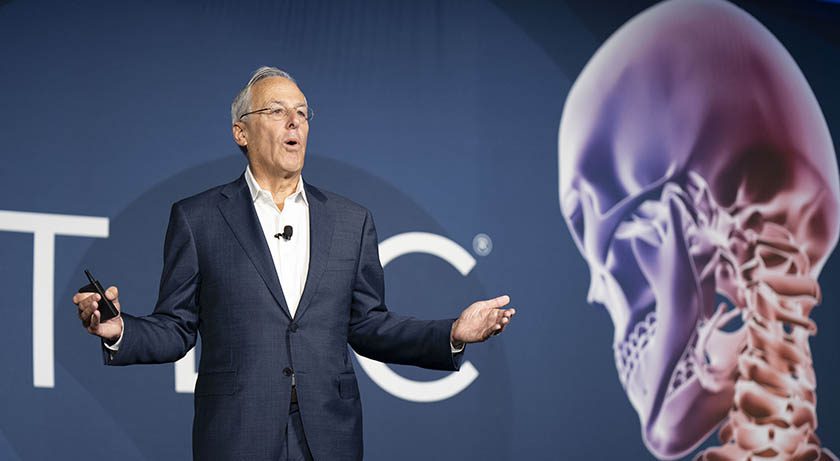
The future of orthopedics is digital: connected ecosystems of technology that collect data and optimize the work of orthopedic companies, surgeons and their staff to provide patients with personalized care and improved outcomes. That’s the message Robert Cohen, Vice President of Innovation and Technology for Stryker’s orthopaedics division, laid out as he provided OMTEC attendees a roadmap for the industry.
“There’s an expectation that if orthopedic companies want to be competitive, an implant alone won’t do it,” Mr. Cohen said. “You have to provide data on the patient.”
Additively manufactured implants, artificial intelligence, preoperative planning tools, robotic-assisted surgery systems, and postoperative monitoring capture patient data and have been adopted to varying degrees over the last decade, Mr. Cohen said. All of these technologies will gain greater relevance as companies are required by their customers and investors to stop looking at them in isolation and collect and implement digital insights.
What’s Driving the Shift to Digital?
Numerous internal and external dynamics are leading changes across healthcare, such as shifting global demographics, increasing inflation and cost pressures, evolving payment models and advancing technology.
While all of these drivers are affecting medtech valuations and marketing and R&D decision-making, companies should focus on the areas that they can most influence, which are innovations taking place in hardware and software applications, Mr. Cohen said. He called out robotics and automation, personalized treatment paths, applications of AI across customer experience and operations and digital disruption at key touchpoints of the healthcare experience.
Mr. Cohen said that implants must remain an essential focus for companies, but added that just as the industry has learned from past failures in device design and materials, orthopedics is at a juncture where it can’t ignore that one size does not fit all patients. Age, gender, activity level and genome will all be points of data collection to provide implant sizes and shapes personalized for the patient.
“Implants give you range of motion and quality of life; you want them to last a lifetime,” Mr. Cohen said. “With that said, that’s not where the money is going.”
Less than 0.5% of money from venture funds went to implant development startups in the United States last year, Mr. Cohen said. The majority of companies that received funding focused on digital technologies, home health, software for healthcare and enabling technologies like robotics.
“We’re going to ground ourselves and still maintain a strong implant group,” Mr. Cohen said, “but just know, this is what’s changing for us.”
What’s Driving Hospital Decisions?
Orthopedic companies need to embrace digital transformation because it’s already dramatically changing surgeons’ experiences and patients’ expectations, Mr. Cohen said. He pointed to the rise in educated patients asking for specific implants and less invasive procedures, surgeons’ growing desire for more data on patients before entering the operating room, as well as hospitals and the government tracking revision and infection rates.
Artificial intelligence is also being adopted to optimize patient care and operating rooms. Mr. Cohen used the Mayo Clinic as an example, noting that the system is using AI to track the time, surgeon, support staff and complexity of cases to predict and decide how long procedures might take and who among the staff is best to support a patient preoperatively and in the O.R. in the future.
“They now level-load hours to get more procedures done per day out of the same fixed cost people in overhead,” Mr. Cohen said. “If they get one more procedure per day out of every operating room, that is revenue that they’re getting on the same cost basis.”
Orthopedic companies should be concerned about the health of hospitals and consider how their technologies can help surgeons achieve efficiency, Mr. Cohen said.
“The reality is that too many hospitals are not making money in the United States,” he said. “Many hospitals operate on 2% profit margin per year. If there are cuts by CMS by 1%, that profit goes down to 1.2%. They will not invest in capital or keep up their speed in technology, and they will start to fail even faster.”
What’s the Future of Technology?
The first total knee replacement with a Mako robot took place 10 years ago this month. Now, 65% of Stryker’s total knee replacement implants in the U.S. are done robotically, Mako is used in 45,000 procedures a month globally, and the robotic system’s applications have extended to hip, spine and shoulder.
Moving forward, technological advancement will take place at a faster pace and robotics will be just one piece of digital innovation, Mr. Cohen said.
He outlined a future where a surgeon uploads a CT scan, artificial intelligence guides segmentation and preoperative planning, additive manufacturing personalizes the implant shape, a robot and mixed reality are used for placement, and the patient is tracked with sensors postoperatively — for most procedures. Significant advancements will come once companies are able to collect data from multiple technologies and create ecosystems of information, instead of systems that are used in isolation.
Stryker, which had overall revenue of $25.1 billion and orthopedic-related revenue of $11.4 billion in 2025, launched its SmartHospital Platform earlier this year. The platform connects Stryker’s devices and data to support clinical and operational workflows across the continuum of care. For example, ambient intelligence in the O.R. will use sensors, computer vision, AI and contextual data to help surgical teams with setup, staffing needs and technology use. Sensors in Stryker hospital beds can track whether a knee replacement patient stands up.
“We will learn more about the continuum of care of a specific patient with a specific indication than we ever knew before, and surgeons will be able to reduce complications,” Mr. Cohen said.
Orthopedic companies will be forced to think strategically about integrated technologies and services, Mr. Cohen said. While not every company has a broad product offering like Stryker, companies must consider their impact on preoperative and intraoperative workflows, collect data, gain digital insights and implement them to advance care.
“We are being held accountable to a higher standard,” Mr. Cohen said of the industry. “Because of that, we are now looking at orthopedic data in a different way, and all of these technologies contribute to the collection of data in a new way.”
The future of orthopedics is digital: connected ecosystems of technology that collect data and optimize the work of orthopedic companies, surgeons and their staff to provide patients with personalized care and improved outcomes. That’s the message Robert Cohen, Vice President of Innovation and Technology for Stryker’s orthopaedics division, laid...
The future of orthopedics is digital: connected ecosystems of technology that collect data and optimize the work of orthopedic companies, surgeons and their staff to provide patients with personalized care and improved outcomes. That’s the message Robert Cohen, Vice President of Innovation and Technology for Stryker’s orthopaedics division, laid out as he provided OMTEC attendees a roadmap for the industry.
“There’s an expectation that if orthopedic companies want to be competitive, an implant alone won’t do it,” Mr. Cohen said. “You have to provide data on the patient.”
Additively manufactured implants, artificial intelligence, preoperative planning tools, robotic-assisted surgery systems, and postoperative monitoring capture patient data and have been adopted to varying degrees over the last decade, Mr. Cohen said. All of these technologies will gain greater relevance as companies are required by their customers and investors to stop looking at them in isolation and collect and implement digital insights.
What’s Driving the Shift to Digital?
Numerous internal and external dynamics are leading changes across healthcare, such as shifting global demographics, increasing inflation and cost pressures, evolving payment models and advancing technology.
While all of these drivers are affecting medtech valuations and marketing and R&D decision-making, companies should focus on the areas that they can most influence, which are innovations taking place in hardware and software applications, Mr. Cohen said. He called out robotics and automation, personalized treatment paths, applications of AI across customer experience and operations and digital disruption at key touchpoints of the healthcare experience.
Mr. Cohen said that implants must remain an essential focus for companies, but added that just as the industry has learned from past failures in device design and materials, orthopedics is at a juncture where it can’t ignore that one size does not fit all patients. Age, gender, activity level and genome will all be points of data collection to provide implant sizes and shapes personalized for the patient.
“Implants give you range of motion and quality of life; you want them to last a lifetime,” Mr. Cohen said. “With that said, that’s not where the money is going.”
Less than 0.5% of money from venture funds went to implant development startups in the United States last year, Mr. Cohen said. The majority of companies that received funding focused on digital technologies, home health, software for healthcare and enabling technologies like robotics.
“We’re going to ground ourselves and still maintain a strong implant group,” Mr. Cohen said, “but just know, this is what’s changing for us.”
What’s Driving Hospital Decisions?
Orthopedic companies need to embrace digital transformation because it’s already dramatically changing surgeons’ experiences and patients’ expectations, Mr. Cohen said. He pointed to the rise in educated patients asking for specific implants and less invasive procedures, surgeons’ growing desire for more data on patients before entering the operating room, as well as hospitals and the government tracking revision and infection rates.
Artificial intelligence is also being adopted to optimize patient care and operating rooms. Mr. Cohen used the Mayo Clinic as an example, noting that the system is using AI to track the time, surgeon, support staff and complexity of cases to predict and decide how long procedures might take and who among the staff is best to support a patient preoperatively and in the O.R. in the future.
“They now level-load hours to get more procedures done per day out of the same fixed cost people in overhead,” Mr. Cohen said. “If they get one more procedure per day out of every operating room, that is revenue that they’re getting on the same cost basis.”
Orthopedic companies should be concerned about the health of hospitals and consider how their technologies can help surgeons achieve efficiency, Mr. Cohen said.
“The reality is that too many hospitals are not making money in the United States,” he said. “Many hospitals operate on 2% profit margin per year. If there are cuts by CMS by 1%, that profit goes down to 1.2%. They will not invest in capital or keep up their speed in technology, and they will start to fail even faster.”
What’s the Future of Technology?
The first total knee replacement with a Mako robot took place 10 years ago this month. Now, 65% of Stryker’s total knee replacement implants in the U.S. are done robotically, Mako is used in 45,000 procedures a month globally, and the robotic system’s applications have extended to hip, spine and shoulder.
Moving forward, technological advancement will take place at a faster pace and robotics will be just one piece of digital innovation, Mr. Cohen said.
He outlined a future where a surgeon uploads a CT scan, artificial intelligence guides segmentation and preoperative planning, additive manufacturing personalizes the implant shape, a robot and mixed reality are used for placement, and the patient is tracked with sensors postoperatively — for most procedures. Significant advancements will come once companies are able to collect data from multiple technologies and create ecosystems of information, instead of systems that are used in isolation.
Stryker, which had overall revenue of $25.1 billion and orthopedic-related revenue of $11.4 billion in 2025, launched its SmartHospital Platform earlier this year. The platform connects Stryker’s devices and data to support clinical and operational workflows across the continuum of care. For example, ambient intelligence in the O.R. will use sensors, computer vision, AI and contextual data to help surgical teams with setup, staffing needs and technology use. Sensors in Stryker hospital beds can track whether a knee replacement patient stands up.
“We will learn more about the continuum of care of a specific patient with a specific indication than we ever knew before, and surgeons will be able to reduce complications,” Mr. Cohen said.
Orthopedic companies will be forced to think strategically about integrated technologies and services, Mr. Cohen said. While not every company has a broad product offering like Stryker, companies must consider their impact on preoperative and intraoperative workflows, collect data, gain digital insights and implement them to advance care.
“We are being held accountable to a higher standard,” Mr. Cohen said of the industry. “Because of that, we are now looking at orthopedic data in a different way, and all of these technologies contribute to the collection of data in a new way.”

You’ve reached your limit.
We’re glad you’re finding value in our content — and we’d love for you to keep going.
Subscribe now for unlimited access to orthopedic business intelligence.

CL
Carolyn LaWell is ORTHOWORLD's Chief Content Officer. She joined ORTHOWORLD in 2012 to oversee its editorial and industry education. She previously served in editor roles at B2B magazines and newspapers.