

 Copy to clipboard
Toward the end of last year we attended MNVC, and we’ve previously written about our takeaways regarding the health of the financial markets. Let’s put a bow on our coverage of the conference by highlighting a few of the more compelling company pitches we saw. Below we discuss the highlights from Abanza Medical, AGADA Medical and HAPPE Spine.
Targeting Innovation Gaps in Sports Medicine
The orthopedic patient population continues to evolve and diversify, but some areas of sports medicine haven’t kept pace. Over the last 20 years, sports medicine products have been designed largely for young male patients. However, demand for sports medicine care for pediatric and female patients has grown substantially.
Abanza is a soft tissue fixation company headquartered in Spain that seeks to address bone quality issues with its WasherCap fixation device.
“The fixation devices designed in the ’80s and ’90s are still used today across all patient populations,” said Abanza Founder and CEO Juan Abascal. “But these patient populations have very different anatomy and quality of bone. Technology should adapt to these new scenarios, because they now represent almost 50% of the soft tissue repair market.”
WasherCap is the first soft tissue graft fixation device that is designed to allow surgeons to perform a fixation that is independent of the bone quality of the patient, which received FDA clearance in late 2022. Abanza followed that up with an early-2025 clearance for WasherCap Mini, which includes uses for meniscal root repair and ACL reconstruction.
Abanza said that its full portfolio will ultimately address 80% of soft tissue cases across all anatomies, and it projects revenue of about $2 million in 2026.
Enabling Technology Veteran Aims to Transform Surgery
Dr. Isador Lieberman has an incredible track record in spine surgery, including over 40 patents and development work on the original Mazor robot. He founded AGADA Medical with the goal of transforming the future of spine surgery.
“CMS paid $1.9 billion for failed spine surgery last year,” said Dr. Liberman. “Across all payors, it was $5.6 billion. Failed back surgery syndrome costs $20 billion a year. These are huge numbers. As surgeons, as good as we think we are, we’re still not good enough. Nearly 40% of what we do does not result in the outcome the patient or surgeon expected. That is a huge burden we are all shouldering economically, but our patients are carrying that burden clinically.”
Surgeons currently lack the ability to quantify the forces across the full length of the spine or predict the clinical outcome of surgical decisions. AGADA Medical aims to transform the art or architecture of spine surgery to the science and engineering of spine surgery.
The company’s technology is software using three modules: human modeling, biomechanical simulation, and a deep learning neural network. These modules assimilate thousands of variables, including anthropometric data, demographic data, and imaging data. The software dynamically reports the likelihood of success of the surgeon’s plan.
AGADA Medical plans to start with point solutions including biomechanics labs and medtech developers who need the segmentation and biomechanical analysis prior to FDA approvals. The company plans to then proceed with application solutions targeting hospitals and physicians, and ultimately systems solutions targeting insurers.
Biomaterial Platform for Bone-Integrating Implants
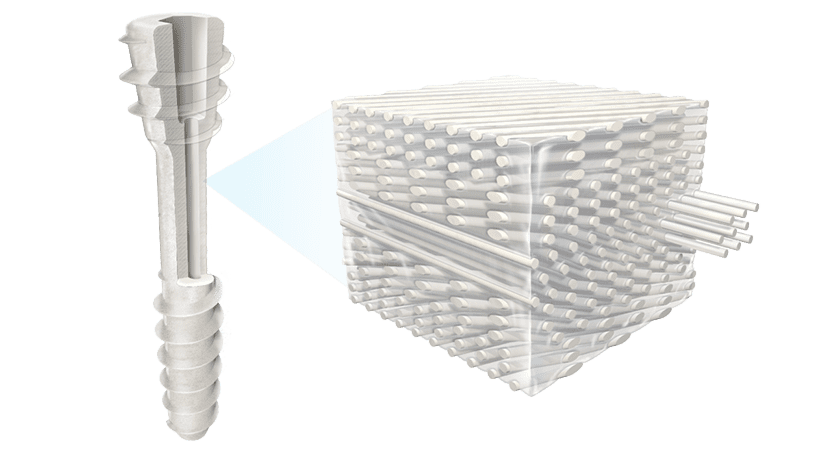
HAPPE Spine has developed a fully synthetic biomaterial platform for bone integrating implants that look and act more like a biologic. The implants feature a bone-like structure and cell-friendly surfaces.
“The market is truly stuck debating the differences between two flawed solutions,” said HAPPE Spine Interim CEO Dr. Ryan K. Roeder. “If you value imaging, if you value load sharing, you prefer PEEK. If you value the porosity for bone ingrowth and you value the surface, you prefer titanium. But you couldn’t have it all until, we believe, our product.”
The company is already well-positioned with 11 issued patents covering the material, the manufacturing process, and the implant designs. It has cleared through a 510(k) pathway and established that pathway for future follow-on products.
The technology has been validated in three clinical studies, with more than 2,000 implants put in more than 1,000 patients. HAPPE Spine also has meaningful commercial traction, with more than $1 million in sales through the first half of 2025.
Like most of the companies pitching at MNVC, HAPPE Spine has aspirations to be a platform technology. Dr. Roeder said the company is a biomaterial platform validating its technology in spine, but potentially has clinical applications in sports medicine, trauma, and foot and ankle.
Toward the end of last year we attended MNVC, and we’ve previously written about our takeaways regarding the health of the financial markets. Let’s put a bow on our coverage of the conference by highlighting a few of the more compelling company pitches we saw. Below we discuss the highlights from Abanza Medical, AGADA Medical and...
Toward the end of last year we attended MNVC, and we’ve previously written about our takeaways regarding the health of the financial markets. Let’s put a bow on our coverage of the conference by highlighting a few of the more compelling company pitches we saw. Below we discuss the highlights from Abanza Medical, AGADA Medical and HAPPE Spine.
Targeting Innovation Gaps in Sports Medicine
The orthopedic patient population continues to evolve and diversify, but some areas of sports medicine haven’t kept pace. Over the last 20 years, sports medicine products have been designed largely for young male patients. However, demand for sports medicine care for pediatric and female patients has grown substantially.
Abanza is a soft tissue fixation company headquartered in Spain that seeks to address bone quality issues with its WasherCap fixation device.
“The fixation devices designed in the ’80s and ’90s are still used today across all patient populations,” said Abanza Founder and CEO Juan Abascal. “But these patient populations have very different anatomy and quality of bone. Technology should adapt to these new scenarios, because they now represent almost 50% of the soft tissue repair market.”
WasherCap is the first soft tissue graft fixation device that is designed to allow surgeons to perform a fixation that is independent of the bone quality of the patient, which received FDA clearance in late 2022. Abanza followed that up with an early-2025 clearance for WasherCap Mini, which includes uses for meniscal root repair and ACL reconstruction.
Abanza said that its full portfolio will ultimately address 80% of soft tissue cases across all anatomies, and it projects revenue of about $2 million in 2026.
Enabling Technology Veteran Aims to Transform Surgery
Dr. Isador Lieberman has an incredible track record in spine surgery, including over 40 patents and development work on the original Mazor robot. He founded AGADA Medical with the goal of transforming the future of spine surgery.
“CMS paid $1.9 billion for failed spine surgery last year,” said Dr. Liberman. “Across all payors, it was $5.6 billion. Failed back surgery syndrome costs $20 billion a year. These are huge numbers. As surgeons, as good as we think we are, we’re still not good enough. Nearly 40% of what we do does not result in the outcome the patient or surgeon expected. That is a huge burden we are all shouldering economically, but our patients are carrying that burden clinically.”
Surgeons currently lack the ability to quantify the forces across the full length of the spine or predict the clinical outcome of surgical decisions. AGADA Medical aims to transform the art or architecture of spine surgery to the science and engineering of spine surgery.
The company’s technology is software using three modules: human modeling, biomechanical simulation, and a deep learning neural network. These modules assimilate thousands of variables, including anthropometric data, demographic data, and imaging data. The software dynamically reports the likelihood of success of the surgeon’s plan.
AGADA Medical plans to start with point solutions including biomechanics labs and medtech developers who need the segmentation and biomechanical analysis prior to FDA approvals. The company plans to then proceed with application solutions targeting hospitals and physicians, and ultimately systems solutions targeting insurers.
Biomaterial Platform for Bone-Integrating Implants
HAPPE Spine has developed a fully synthetic biomaterial platform for bone integrating implants that look and act more like a biologic. The implants feature a bone-like structure and cell-friendly surfaces.
“The market is truly stuck debating the differences between two flawed solutions,” said HAPPE Spine Interim CEO Dr. Ryan K. Roeder. “If you value imaging, if you value load sharing, you prefer PEEK. If you value the porosity for bone ingrowth and you value the surface, you prefer titanium. But you couldn’t have it all until, we believe, our product.”
The company is already well-positioned with 11 issued patents covering the material, the manufacturing process, and the implant designs. It has cleared through a 510(k) pathway and established that pathway for future follow-on products.
The technology has been validated in three clinical studies, with more than 2,000 implants put in more than 1,000 patients. HAPPE Spine also has meaningful commercial traction, with more than $1 million in sales through the first half of 2025.
Like most of the companies pitching at MNVC, HAPPE Spine has aspirations to be a platform technology. Dr. Roeder said the company is a biomaterial platform validating its technology in spine, but potentially has clinical applications in sports medicine, trauma, and foot and ankle.

You’ve reached your limit.
We’re glad you’re finding value in our content — and we’d love for you to keep going.
Subscribe now for unlimited access to orthopedic business intelligence.

ME
Mike Evers is a Senior Market Analyst and writer with over 15 years of experience in the medical industry, spanning cardiac rhythm management, ER coding and billing, and orthopedics. He joined ORTHOWORLD in 2018, where he provides market analysis and editorial coverage.