

 Copy to clipboard
Metal has dominated orthopedic fixation — a stubborn status quo in a field that’s otherwise embraced innovation. Previous attempts at non-permanent implants such as bioresorbables and polymer-based biocomposites showed promise, but ultimately missed the mark on biocompatibility and strength, leaving industry skeptical and surgeons feeling burned.
So, does industry leave things as-is and keep with metal as the material of choice for nearly all implants? Consider this: One in four patients with metal implants undergoes a second operation for hardware removal worldwide. In the U.S. alone, $1.5 billion is spent annually on hardware removal surgery.
OSSIO, founded in 2014, doesn’t think that’s acceptable. The company believes its OSSIOfiber bone mineral-based material platform cracks the code, staking a claim to a new “bio-integrative” category. Brennan Marilla, Chief Commercial and Operating Officer, contrasts the orthopedic industry’s lack of fixation innovation with the advances in the aerospace industry.
“If you’ve ever seen SpaceX go over your head, it looks like Star Wars. You can’t believe the streaks in the sky,” he said. “When I saw it, I thought, how is it that we have reusable rockets that can be caught with chopsticks, we’re possibly going to Mars in the next decade, and yet we’re still using metal screws that have been around since the French Revolution. OSSIO feels a responsibility to change that.”
Transforming the Orthopedic Industry
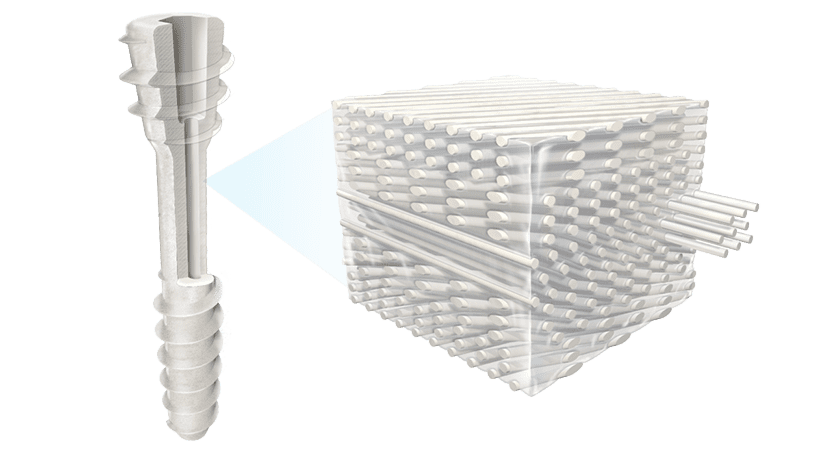
OSSIOfiber is a matrix of thousands of continuous bone mineral fibers that, together, are 1.5x stronger than cortical bone and 5x stronger than common bioresorbables. Using silicon dioxide, sodium oxide, calcium oxide, magnesium oxide, boron trioxide, and phosphorus pentoxide, the company organizes in new ways minerals that have been in clinical use for more than 30 years, creating implants that are MRI safe, and artifact-free on x-ray and CT—a meaningful differentiator for post-op imaging.
“OSSIOfiber has a completely different material composition,” Marilla said. “We have a different way of manufacturing—layering fibers, almost like a weave—to make them incredibly strong.”
Upon implantation, fluid exchange triggers bone-forming cells to migrate onto and eventually through the implant, which fully remodels into the native anatomy. Bone attachment begins in as little as two weeks, and full integration occurs within 18-24 months, with no adverse inflammatory response and no hardware left behind. OSSIOfiber’s polymer content (PLDLA) functions only as a binder and is largely eliminated by the body well before full integration.
“The composition of materials within the implant mimics that of the native bone itself,” said Brian Verrier, Chief Executive Officer at OSSIO.
Developed over more than a decade by Founder and Chief Innovation Officer Orahn Preiss-Bloom, OSSIOfiber works within existing surgical techniques and existing reimbursement codes, making it easier for surgeons and their clinical teams to use.
Gaining Commercial Traction
OSSIO launched commercially in the U.S. in 2019 with the hammertoe bone pin. Since then, the company’s notable product launches have included compression screws, the first and only non-permanent compression staple, a 2.5mm suture anchor and the MIA bunion correction system.
OSSIO reached $40 million in revenue in 2025 and is tracking toward $60 million in 2026. Over six years of U.S. commercialization, surgeons have placed 80,000+ OSSIO implants. The company also boasts 1,500 active surgeons, 400+ active sales personnel in the U.S., and approximately 165 employees. And they’re not slowing down.
Building on that initial hammertoe fixation system and trimmable fixation nails, OSSIO’s platform technology has been in constant expansion mode. Currently, the company has products and portfolios in foot & ankle, pediatrics, and sports medicine.
Its portfolio for foot and ankle includes compression screws, a compression staple, trimmable nails, and threaded trimmable nails, with hundreds of SKUs. The MIA Bunion (Minimally Invasive All-Natural Bunion Correction System), launched in early 2026, uses OSSIOfiber’s threaded trimmable nails — the play on words is a nod to the hardware literally missing on post-op x-rays. The company is also working on a plate platform with an expected launch in early 2027.
OSSIO’s implants were cleared for pediatric use in December 2023, and its 2.5mm suture anchor was cleared for children as young as two years old in June 2025. The removal-avoidance benefit is particularly beneficial in peds, a patient population in which hardware removal rates are high with growing bones.
Sports medicine is a hot area of focus for the company. Preiss-Bloom cited the development of joint-preserving solutions as a major orthopedic trend and said OSSIOfiber is being used in conjunction with a growing ecosystem of complementary technologies in this space, particularly in areas like soft tissue augmentation.
Many surgeons now perform ACL repair with OSSIOfiber anchors. The suture anchor platform is currently OSSIO’s fastest-growing, highest-volume product. During ACL reconstruction, surgeons often perform an LET at the same time and use fully threaded Trimmable Fixation Nails. This product is trimmed and re-threaded to custom length in the O.R. to directly address the tray management burden of metal screw inventories.
The KneeBar procedure is arguably OSSIO’s biggest emerging growth driver. The technique targets subchondral insufficiency fractures, the underlying mechanism driving early-onset knee pain and arthritis in younger, active patients not yet candidates for knee replacement. Originating with Dr. Brian Cole at Rush University, the procedure uses OSSIOfiber nails to “rebar” and support the subchondral bone while osteoconductive properties stimulate new bone growth. In a small pilot study, eight of nine patients showed complete pain resolution at the two-year mark with full return to normal activities.
“One of the biggest challenges for our company is deciding where to focus our efforts,” Marilla said. “Because OSSIOfiber is a platform technology, we could go in so many different directions.”
Expanding and Evolving
OSSIO is ready to take the next step in its evolution. With a new 30,000 sq ft facility in Palmetto, Florida that serves as its U.S. headquarters and can support up to $160 million in revenue capacity, the company is investing in surgeon training and expanding in-house manufacturing of OSSIOfiber implants.
“Making OSSIOfiber takes a lot of technical know-how,” Marilla said. “We layer the fibers by hand into molds, and then compression mold them. That’s not a process we wanted to outsource because we’re really good at it. Our yields are extremely high, and our team has great expertise in making these types of implants.”
The U.S. facility joins OSSIO’s existing Caesarea, Israel site, where all R&D, regulatory, and quality functions remain. New platform products are manufactured at the Israel location for R&D proximity before eventual transfer to the Florida site, which Preiss-Bloom said will foster stronger connections with U.S.-based surgeons and distributors.
According to OSSIO’s leadership, the company will maintain strong internal R&D while remaining inquisitive about external opportunities.
“We’re interested in looking at business development that fits our brand of making orthopedics more biologic, encouraging natural healing, and moving away from permanent implants,” Marilla said. “There are technologies out there that could help us enable the ease of use of our technology, or are biologics that could be used in conjunction with our call points that would enhance what we’re doing.”
Metal has dominated orthopedic fixation — a stubborn status quo in a field that’s otherwise embraced innovation. Previous attempts at non-permanent implants such as bioresorbables and polymer-based biocomposites showed promise, but ultimately missed the mark on biocompatibility and strength, leaving industry skeptical and surgeons feeling...
Metal has dominated orthopedic fixation — a stubborn status quo in a field that’s otherwise embraced innovation. Previous attempts at non-permanent implants such as bioresorbables and polymer-based biocomposites showed promise, but ultimately missed the mark on biocompatibility and strength, leaving industry skeptical and surgeons feeling burned.
So, does industry leave things as-is and keep with metal as the material of choice for nearly all implants? Consider this: One in four patients with metal implants undergoes a second operation for hardware removal worldwide. In the U.S. alone, $1.5 billion is spent annually on hardware removal surgery.
OSSIO, founded in 2014, doesn’t think that’s acceptable. The company believes its OSSIOfiber bone mineral-based material platform cracks the code, staking a claim to a new “bio-integrative” category. Brennan Marilla, Chief Commercial and Operating Officer, contrasts the orthopedic industry’s lack of fixation innovation with the advances in the aerospace industry.
“If you’ve ever seen SpaceX go over your head, it looks like Star Wars. You can’t believe the streaks in the sky,” he said. “When I saw it, I thought, how is it that we have reusable rockets that can be caught with chopsticks, we’re possibly going to Mars in the next decade, and yet we’re still using metal screws that have been around since the French Revolution. OSSIO feels a responsibility to change that.”
Transforming the Orthopedic Industry
OSSIOfiber is a matrix of thousands of continuous bone mineral fibers that, together, are 1.5x stronger than cortical bone and 5x stronger than common bioresorbables. Using silicon dioxide, sodium oxide, calcium oxide, magnesium oxide, boron trioxide, and phosphorus pentoxide, the company organizes in new ways minerals that have been in clinical use for more than 30 years, creating implants that are MRI safe, and artifact-free on x-ray and CT—a meaningful differentiator for post-op imaging.
“OSSIOfiber has a completely different material composition,” Marilla said. “We have a different way of manufacturing—layering fibers, almost like a weave—to make them incredibly strong.”
Upon implantation, fluid exchange triggers bone-forming cells to migrate onto and eventually through the implant, which fully remodels into the native anatomy. Bone attachment begins in as little as two weeks, and full integration occurs within 18-24 months, with no adverse inflammatory response and no hardware left behind. OSSIOfiber’s polymer content (PLDLA) functions only as a binder and is largely eliminated by the body well before full integration.
“The composition of materials within the implant mimics that of the native bone itself,” said Brian Verrier, Chief Executive Officer at OSSIO.
Developed over more than a decade by Founder and Chief Innovation Officer Orahn Preiss-Bloom, OSSIOfiber works within existing surgical techniques and existing reimbursement codes, making it easier for surgeons and their clinical teams to use.
Gaining Commercial Traction
OSSIO launched commercially in the U.S. in 2019 with the hammertoe bone pin. Since then, the company’s notable product launches have included compression screws, the first and only non-permanent compression staple, a 2.5mm suture anchor and the MIA bunion correction system.
OSSIO reached $40 million in revenue in 2025 and is tracking toward $60 million in 2026. Over six years of U.S. commercialization, surgeons have placed 80,000+ OSSIO implants. The company also boasts 1,500 active surgeons, 400+ active sales personnel in the U.S., and approximately 165 employees. And they’re not slowing down.
Building on that initial hammertoe fixation system and trimmable fixation nails, OSSIO’s platform technology has been in constant expansion mode. Currently, the company has products and portfolios in foot & ankle, pediatrics, and sports medicine.
Its portfolio for foot and ankle includes compression screws, a compression staple, trimmable nails, and threaded trimmable nails, with hundreds of SKUs. The MIA Bunion (Minimally Invasive All-Natural Bunion Correction System), launched in early 2026, uses OSSIOfiber’s threaded trimmable nails — the play on words is a nod to the hardware literally missing on post-op x-rays. The company is also working on a plate platform with an expected launch in early 2027.
OSSIO’s implants were cleared for pediatric use in December 2023, and its 2.5mm suture anchor was cleared for children as young as two years old in June 2025. The removal-avoidance benefit is particularly beneficial in peds, a patient population in which hardware removal rates are high with growing bones.
Sports medicine is a hot area of focus for the company. Preiss-Bloom cited the development of joint-preserving solutions as a major orthopedic trend and said OSSIOfiber is being used in conjunction with a growing ecosystem of complementary technologies in this space, particularly in areas like soft tissue augmentation.
Many surgeons now perform ACL repair with OSSIOfiber anchors. The suture anchor platform is currently OSSIO’s fastest-growing, highest-volume product. During ACL reconstruction, surgeons often perform an LET at the same time and use fully threaded Trimmable Fixation Nails. This product is trimmed and re-threaded to custom length in the O.R. to directly address the tray management burden of metal screw inventories.
The KneeBar procedure is arguably OSSIO’s biggest emerging growth driver. The technique targets subchondral insufficiency fractures, the underlying mechanism driving early-onset knee pain and arthritis in younger, active patients not yet candidates for knee replacement. Originating with Dr. Brian Cole at Rush University, the procedure uses OSSIOfiber nails to “rebar” and support the subchondral bone while osteoconductive properties stimulate new bone growth. In a small pilot study, eight of nine patients showed complete pain resolution at the two-year mark with full return to normal activities.
“One of the biggest challenges for our company is deciding where to focus our efforts,” Marilla said. “Because OSSIOfiber is a platform technology, we could go in so many different directions.”
Expanding and Evolving
OSSIO is ready to take the next step in its evolution. With a new 30,000 sq ft facility in Palmetto, Florida that serves as its U.S. headquarters and can support up to $160 million in revenue capacity, the company is investing in surgeon training and expanding in-house manufacturing of OSSIOfiber implants.
“Making OSSIOfiber takes a lot of technical know-how,” Marilla said. “We layer the fibers by hand into molds, and then compression mold them. That’s not a process we wanted to outsource because we’re really good at it. Our yields are extremely high, and our team has great expertise in making these types of implants.”
The U.S. facility joins OSSIO’s existing Caesarea, Israel site, where all R&D, regulatory, and quality functions remain. New platform products are manufactured at the Israel location for R&D proximity before eventual transfer to the Florida site, which Preiss-Bloom said will foster stronger connections with U.S.-based surgeons and distributors.
According to OSSIO’s leadership, the company will maintain strong internal R&D while remaining inquisitive about external opportunities.
“We’re interested in looking at business development that fits our brand of making orthopedics more biologic, encouraging natural healing, and moving away from permanent implants,” Marilla said. “There are technologies out there that could help us enable the ease of use of our technology, or are biologics that could be used in conjunction with our call points that would enhance what we’re doing.”

You’ve reached your limit.
We’re glad you’re finding value in our content — and we’d love for you to keep going.
Subscribe now for unlimited access to orthopedic business intelligence.

HT
Heather Tunstall is an ORTHOWORLD Contributor and owner of Tunstall Content.