

 Copy to clipboard
Stryker’s sports medicine business has outpaced the market in recent years and grown to be the third largest player in the segment, according to our estimates. That growth has come from the steady launch of new products, including the AlphaVent Knotless, Knotilus+, Iconix Knotless and Iconix HA+ anchors, and alongside the company’s 2024 acquisition of Artelon.
As an increasingly strong player in the $7.5 billion sports medicine market, we asked Matt Moreau about the unmet clinical needs and future technology that is expected to drive growth for Stryker and the overall segment. Mr. Moreau is Vice President and General Manager of the company’s Sports Medicine Business Unit within the Endoscopy Division, which he has led for the past 14 years.
Mr. Moreau noted two clear trends that could disrupt and shift the sports medicine market: biologic augmentation to improve the healing process of soft tissue and the integration of enabling technologies into the surgeons’ workflow.
“The sports medicine industry has done an excellent job over time optimizing mechanical fixation and creating solutions to help improve surgical workflow,” Mr. Moreau said. “With that said, there remains a significant opportunity to couple improved mechanical fixation with biologic enhancement to improve healing, as well as leveraging technology to aid in pre-operative and intra-operative decision-making.”
What are the most pressing unmet needs in sports medicine today?
Mr. Moreau: There are a few key areas. The first is defining areas to enhance the biology of soft tissue repairs, aiming to increase healing rates and facilitate a return to life or sport for patients. I emphasize defining those areas to enhance biology because it is a balance between credible science, a defined regulatory pathway and ensuring it is not cost-prohibitive, especially with the mix of our procedural volume in the ASC.
Another area of unmet need is leveraging new technology blocks to provide information pre-operatively and/or intra-operatively to support surgeons in their clinical decision making. These decisions can be specific to the patient to optimize the use of current mechanical solutions or better inform the use of a biologic. As technology and specifically AI advance quickly, targeting the right enabling technologies that create value today for the surgeon but also have a product life cycle that can be managed effectively by industry given the rapid rate of change will be the key for all of us in successfully meeting the unmet needs of our customers with new tech blocks.
Let’s take those trends one at a time. How are you approaching the integration of biologics, scaffolds or regenerative medicine into your portfolio?
Mr. Moreau: We have a significant interest in this area given the clinical need, and our focus is both internal and external. For example, we acquired Artelon last year, which added a unique scaffold to our portfolio and introduced a new internal polymer manufacturing competency to our team. We will continue to focus on this area as technologies and science advance, and our approach will define targeted areas where science, procedural efficiency, path to market, and cost structure come together to ensure we deliver across those dimensions for our customers.
How do you see robotics or digital technologies shaping the sports medicine field?
Mr. Moreau: Obviously robotics has become critical in advancing total joint reconstruction and soft tissue general surgery, so we are keeping an open and inquisitive mind on what form factor that could look like in the field of sports medicine, especially given the broad range of procedures, clinical opportunities and being able to deliver on the workflow needed in a minimally invasive environment. In the near term, we believe there are numerous opportunities in digital technologies that will play a key role in supporting surgeons in how they treat bony and soft tissue pathologies, and we have active platforms in the market today that we intend to build upon.
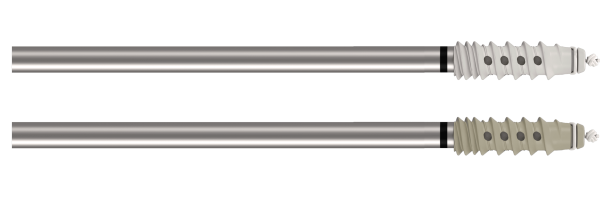
Stryker’s AlphaVent Bio (top) and AlphaVent PEEK (bottom) are versatile and strong suture anchors meant for a multitude of sports medicine procedures.
How are patient demographics—like younger athletes vs. aging active adults—changing the approach to product development?
Mr. Moreau: While our team is passionate and focused on developing innovation that improves the outcomes from a pediatric setting to aging active adults, which has not changed over time, new technology blocks are allowing us to take a more targeted focus on patient-specific technologies. Those technologies have enabled us to think more specifically about how we support our customers in ensuring the right products and procedures are chosen for the right patient, given the unique pathologies as well as the goals of the patient.
We have your sports medicine business growing above the market average in recent years. What is driving your growth?
Mr. Moreau: Innovation and a significant cadence of product launches in recent years have been driving our growth, but the real differentiator behind the numbers is the people. We have an extremely talented team that is passionate about the sports medicine space, laser focused on customers, and also having a lot of fun along the way. The customer-centric culture starts with our early concept leaders and extends to our sales team.
We have also been fortunate to work with a group of surgeons who not only have incredible minds but also are exceptional people. They have greatly helped us target and accelerate our internal innovation, as well as evaluate external technologies. I feel very proud and grateful for the Stryker team I get the chance to line up with every day, as well as the surgeons we work with. That has been the ultimate differentiator behind the numbers.
What lessons can sports medicine learn from Stryker’s other subspecialties?
Mr. Moreau: I think we can learn a lot across other subspecialties whether it is the mechanical or the digital spaces. We try to challenge ourselves to look at technology that may be further from sports medicine — general surgery and cardiac, as examples — to see if there is innovation where the dots may not have been connected to sports, but are trying to solve similar soft tissue challenges.
I also think there is a lot to learn from technologies that have been successful or missed the market based on value creation for the customer and being critical of where those analogs might apply for us to help inform our future direction. Often times we find that our misses or those in other subspecialties are the most informative to pressure test our assumption sets, to help ensure we have conviction on our strategy.
Stryker’s sports medicine business has outpaced the market in recent years and grown to be the third largest player in the segment, according to our estimates. That growth has come from the steady launch of new products, including the AlphaVent Knotless, Knotilus+, Iconix Knotless and Iconix HA+ anchors, and alongside the company’s 2024...
Stryker’s sports medicine business has outpaced the market in recent years and grown to be the third largest player in the segment, according to our estimates. That growth has come from the steady launch of new products, including the AlphaVent Knotless, Knotilus+, Iconix Knotless and Iconix HA+ anchors, and alongside the company’s 2024 acquisition of Artelon.
As an increasingly strong player in the $7.5 billion sports medicine market, we asked Matt Moreau about the unmet clinical needs and future technology that is expected to drive growth for Stryker and the overall segment. Mr. Moreau is Vice President and General Manager of the company’s Sports Medicine Business Unit within the Endoscopy Division, which he has led for the past 14 years.
Mr. Moreau noted two clear trends that could disrupt and shift the sports medicine market: biologic augmentation to improve the healing process of soft tissue and the integration of enabling technologies into the surgeons’ workflow.
“The sports medicine industry has done an excellent job over time optimizing mechanical fixation and creating solutions to help improve surgical workflow,” Mr. Moreau said. “With that said, there remains a significant opportunity to couple improved mechanical fixation with biologic enhancement to improve healing, as well as leveraging technology to aid in pre-operative and intra-operative decision-making.”
What are the most pressing unmet needs in sports medicine today?
Mr. Moreau: There are a few key areas. The first is defining areas to enhance the biology of soft tissue repairs, aiming to increase healing rates and facilitate a return to life or sport for patients. I emphasize defining those areas to enhance biology because it is a balance between credible science, a defined regulatory pathway and ensuring it is not cost-prohibitive, especially with the mix of our procedural volume in the ASC.
Another area of unmet need is leveraging new technology blocks to provide information pre-operatively and/or intra-operatively to support surgeons in their clinical decision making. These decisions can be specific to the patient to optimize the use of current mechanical solutions or better inform the use of a biologic. As technology and specifically AI advance quickly, targeting the right enabling technologies that create value today for the surgeon but also have a product life cycle that can be managed effectively by industry given the rapid rate of change will be the key for all of us in successfully meeting the unmet needs of our customers with new tech blocks.
Let’s take those trends one at a time. How are you approaching the integration of biologics, scaffolds or regenerative medicine into your portfolio?
Mr. Moreau: We have a significant interest in this area given the clinical need, and our focus is both internal and external. For example, we acquired Artelon last year, which added a unique scaffold to our portfolio and introduced a new internal polymer manufacturing competency to our team. We will continue to focus on this area as technologies and science advance, and our approach will define targeted areas where science, procedural efficiency, path to market, and cost structure come together to ensure we deliver across those dimensions for our customers.
How do you see robotics or digital technologies shaping the sports medicine field?
Mr. Moreau: Obviously robotics has become critical in advancing total joint reconstruction and soft tissue general surgery, so we are keeping an open and inquisitive mind on what form factor that could look like in the field of sports medicine, especially given the broad range of procedures, clinical opportunities and being able to deliver on the workflow needed in a minimally invasive environment. In the near term, we believe there are numerous opportunities in digital technologies that will play a key role in supporting surgeons in how they treat bony and soft tissue pathologies, and we have active platforms in the market today that we intend to build upon.
Stryker’s AlphaVent Bio (top) and AlphaVent PEEK (bottom) are versatile and strong suture anchors meant for a multitude of sports medicine procedures.
How are patient demographics—like younger athletes vs. aging active adults—changing the approach to product development?
Mr. Moreau: While our team is passionate and focused on developing innovation that improves the outcomes from a pediatric setting to aging active adults, which has not changed over time, new technology blocks are allowing us to take a more targeted focus on patient-specific technologies. Those technologies have enabled us to think more specifically about how we support our customers in ensuring the right products and procedures are chosen for the right patient, given the unique pathologies as well as the goals of the patient.
We have your sports medicine business growing above the market average in recent years. What is driving your growth?
Mr. Moreau: Innovation and a significant cadence of product launches in recent years have been driving our growth, but the real differentiator behind the numbers is the people. We have an extremely talented team that is passionate about the sports medicine space, laser focused on customers, and also having a lot of fun along the way. The customer-centric culture starts with our early concept leaders and extends to our sales team.
We have also been fortunate to work with a group of surgeons who not only have incredible minds but also are exceptional people. They have greatly helped us target and accelerate our internal innovation, as well as evaluate external technologies. I feel very proud and grateful for the Stryker team I get the chance to line up with every day, as well as the surgeons we work with. That has been the ultimate differentiator behind the numbers.
What lessons can sports medicine learn from Stryker’s other subspecialties?
Mr. Moreau: I think we can learn a lot across other subspecialties whether it is the mechanical or the digital spaces. We try to challenge ourselves to look at technology that may be further from sports medicine — general surgery and cardiac, as examples — to see if there is innovation where the dots may not have been connected to sports, but are trying to solve similar soft tissue challenges.
I also think there is a lot to learn from technologies that have been successful or missed the market based on value creation for the customer and being critical of where those analogs might apply for us to help inform our future direction. Often times we find that our misses or those in other subspecialties are the most informative to pressure test our assumption sets, to help ensure we have conviction on our strategy.

You’ve reached your limit.
We’re glad you’re finding value in our content — and we’d love for you to keep going.
Subscribe now for unlimited access to orthopedic business intelligence.

CL
Carolyn LaWell is ORTHOWORLD's Chief Content Officer. She joined ORTHOWORLD in 2012 to oversee its editorial and industry education. She previously served in editor roles at B2B magazines and newspapers.