

 Copy to clipboard
Spinal Resources (SRI) was issued U.S. Patent No. 12,611,231, Spinal Rod and Systems Thereof. The patent extends the protection secured by SRI’s previously issued U.S. Patent No. 12,251,133, granted last year. Together, the two issued patents create a layered intellectual property position covering the company’s proprietary multi-diameter, variable-stiffness spinal fixation platform. From the rod itself to the full implant system, the AI-enabled design methodology tailors each rod to the individual patient.
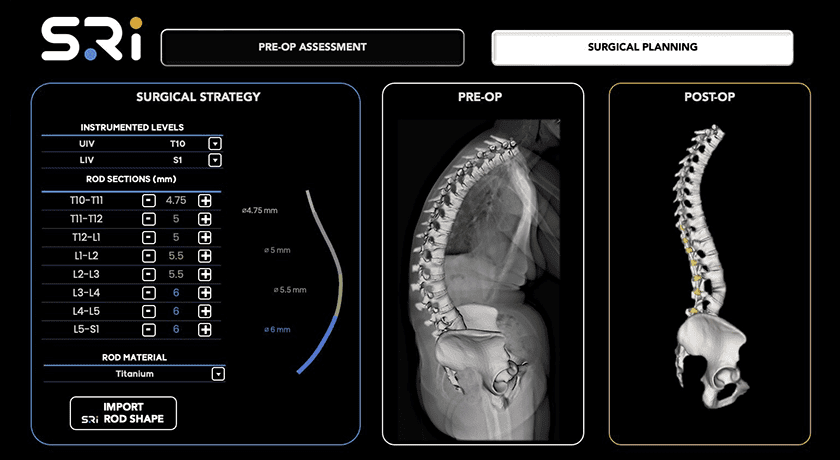
Conventional posterior spinal fixation rods carry a single constant diameter along their full length, forcing surgeons to accept a uniform stiffness profile poorly matched to the variable anatomy and bone quality of the spinal column. Earlier “stepped” designs introduced abrupt diameter changes that created stress concentrations and restricted screw placement. The patented Spinal Resources design replaces abrupt transitions with smooth, continuous Bezier curve geometry, enabling segment-by-segment customization of the rod cross-section along its entire length.
The two issued patents operate as complementary layers of protection. U.S. Patent No. 12,251,133 — Variable-Dimension Fixation Rod and Implantable Stabilization System Including a Variable-Dimension Fixation Rod — protects the variable-diameter rod as part of a broader implantable stabilization system. The Bezier rod in combination with pedicle screw and retaining cap assemblies, including the smooth transition regions, enable the securing of fasteners at any point along the Bezier rod.
U.S. Patent No. 12,611,231 — Spinal Rod and Systems Thereof — extends this foundation by covering the rod itself independently of any specific fastener system. It broadens protection beyond the system-level configuration and supports patient-specific customization driven by data and algorithms to determine optimal rod shape and cross-section for each patient. It addresses advanced geometric features, such as morphotypes rod contours, not addressed in the earlier patent. In combination, the two patents are intended to provide overlapping protection across the product; from the rod itself to the rod-and-fastener system, to the software-driven design methodology.
Source: Spinal Resources, Inc.
Spinal Resources (SRI) was issued U.S. Patent No. 12,611,231, Spinal Rod and Systems Thereof. The patent extends the protection secured by SRI's previously issued U.S. Patent No. 12,251,133, granted last year. Together, the two issued patents create a layered intellectual property position covering the company's proprietary multi-diameter,...
Spinal Resources (SRI) was issued U.S. Patent No. 12,611,231, Spinal Rod and Systems Thereof. The patent extends the protection secured by SRI’s previously issued U.S. Patent No. 12,251,133, granted last year. Together, the two issued patents create a layered intellectual property position covering the company’s proprietary multi-diameter, variable-stiffness spinal fixation platform. From the rod itself to the full implant system, the AI-enabled design methodology tailors each rod to the individual patient.
Conventional posterior spinal fixation rods carry a single constant diameter along their full length, forcing surgeons to accept a uniform stiffness profile poorly matched to the variable anatomy and bone quality of the spinal column. Earlier “stepped” designs introduced abrupt diameter changes that created stress concentrations and restricted screw placement. The patented Spinal Resources design replaces abrupt transitions with smooth, continuous Bezier curve geometry, enabling segment-by-segment customization of the rod cross-section along its entire length.
The two issued patents operate as complementary layers of protection. U.S. Patent No. 12,251,133 — Variable-Dimension Fixation Rod and Implantable Stabilization System Including a Variable-Dimension Fixation Rod — protects the variable-diameter rod as part of a broader implantable stabilization system. The Bezier rod in combination with pedicle screw and retaining cap assemblies, including the smooth transition regions, enable the securing of fasteners at any point along the Bezier rod.
U.S. Patent No. 12,611,231 — Spinal Rod and Systems Thereof — extends this foundation by covering the rod itself independently of any specific fastener system. It broadens protection beyond the system-level configuration and supports patient-specific customization driven by data and algorithms to determine optimal rod shape and cross-section for each patient. It addresses advanced geometric features, such as morphotypes rod contours, not addressed in the earlier patent. In combination, the two patents are intended to provide overlapping protection across the product; from the rod itself to the rod-and-fastener system, to the software-driven design methodology.
Source: Spinal Resources, Inc.

You’ve reached your limit.
We’re glad you’re finding value in our content — and we’d love for you to keep going.
Subscribe now for unlimited access to orthopedic business intelligence.

JV
Julie Vetalice is ORTHOWORLD's Editorial Assistant. She has covered the orthopedic industry for over 20 years, having joined the company in 1999.