

 Copy to clipboard
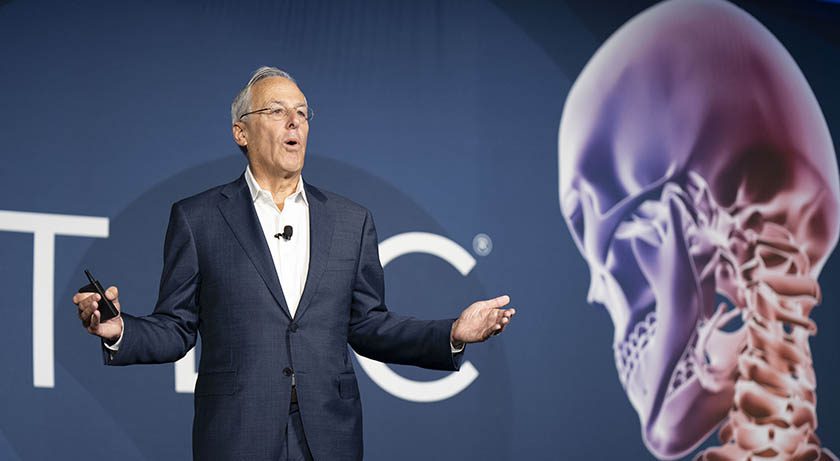
Advances in enabling and digital technologies, the shift of procedures to the ASC setting, and the simplification and scalability of products will drive the future of orthopedics, said leaders from the big four orthopedic companies when they took the stage together at the AAOS and HealthpointCapital Investor Forum.
CEOs and Presidents from Stryker, DePuy Synthes, Zimmer Biomet, and Smith+Nephew spoke to a room of industry professionals and surgeons, offering insights into the future of orthopedics and advice for companies seeking to be acquired.
These four companies together hold 50% of the global orthopedic market share and lead the industry in M&A transactions. The executives said their companies will remain risk-averse and look to small companies to take on the long cycles of bringing innovative technologies to market. Their guidance for small companies was to maintain focus. Companies that seek to be acquired should build deep channels, not wide ones.
The panel discussion was moderated by HealthpointCapital Managing Director Mike Mogul and included Dylan Crotty, Group President, Orthopaedics at Stryker; Deepak Nath, CEO at Smith+Nephew; Namal Nawana, Worldwide President at DePuy Synthes; and Ivan Tornos, CEO and President at Zimmer Biomet.
Their quotes have been lightly edited for clarity.
Consider How You’re Allocating Funding
Securing funding can be difficult, especially for startups that have not yet received regulatory clearance. Executives advised companies to allocate capital beyond just product development initiatives to become an attractive acquisition in the future.
“Before you start developing the product, think about reimbursement, data and payors,” Mr. Crotty said. “All too often, we see wonderful products and solutions for patients that are too far along to get reimbursed. As we look at companies to acquire, those that have invested in research and data are much more likely to get our attention than those that haven’t. It’s frankly something that takes a significant amount of time, money, and commitment to see through the system.”
“Innovative technologies take time, resilience and funding,” Mr. Namath said. “Companies should be prepared to do an extra [funding] series and talk about it with potential investors. We rely on smaller companies taking risks in a different form than corporations do, and in doing so, you present yourself with more upside and potential rewards.”
Build Relationships with Big Companies
Every technology needs a champion who can convey its benefits and find the right match for purchase. Executives said that small companies should build relationships within large companies to understand better what is needed for an exit.
“Every idea that is brought to us is usually championed by somebody at a director level, general manager level. They become evangelists for these ideas within [our] company and have to convince others to believe. I would encourage you to make those connections within these companies,” Mr. Crotty said. “I need you to come and pitch ideas. Be a bit relentless and push those relationships.”
“Make sure you’re having meaningful engagement because everything comes down to people, and partnerships are important,” Mr. Nath said. “The decisions you make early on will have a profound impact on how the [technology] gets developed and what potential it has. The more that you engage companies, the more you’re going to have a sense of what’s important to companies in the sector who, at the end of the day, own the channel and have the commercial muscle.”
Plan How to Scale
Companies need to consider what their journey might look like over the next decade — not just the next few years. Executives said one of the bigger mistakes they see smaller companies make is developing technologies and sales processes that can’t scale or they scale too quickly and ultimately fail.
“Understand what tier-one level of clinical and commercial support looks like across your scenario planning. Then move to tier two and three. The process is similar to new product development. It’s not what I’m going to do the next two years, it’s what does my journey look like for the next 10 years,” Mr. Tornos said. “Partner with the larger companies. I think all of us have an appetite for distribution and licensing agreements when it makes sense.”
“If I’m you, I’m picking certain geographies around the U.S., around the world, and proving I can be successful in those geographies,” Mr. Crotty said. “How do you go deep in those areas and improve? Maybe you pay those salespeople well and create an environment where they love coming to work and developing as salespeople every day. I think we all probably just ended the tour of sales meetings. That’s the culture you have to create. But stay focused. Expanding too quickly can kill you.”
Think Broadly about Solutions
Innovation in orthopedics is largely focused on new implants and enabling technologies. Still, healthcare systems face significant pressure to decrease the total cost of a procedure — not just the products used during surgery. Executives said companies of all sizes that develop technologies that solve broader challenges will be better positioned.
“We need to think more broadly, open up our aperture for our teams, and it’s especially true for those of us in larger companies. We need to start to think end-to-end,” Mr. Nath said. “The imperative now has never been greater for us to adopt more systems-based thinking so that we can develop more broad-based solutions.”
“There are evolutions in how healthcare is delivered, and we should expect that; we should embrace that,” Mr. Nawana said. “There’s the technology that’s used before we go into a procedure, and there are a bunch of things that we can do to enhance the potential outcome after a procedure. The continuum of care is important as we think about our goals and aspirations.”
Advances in enabling and digital technologies, the shift of procedures to the ASC setting, and the simplification and scalability of products will drive the future of orthopedics, said leaders from the big four orthopedic companies when they took the stage together at the AAOS and HealthpointCapital Investor Forum.
CEOs and Presidents from...
Advances in enabling and digital technologies, the shift of procedures to the ASC setting, and the simplification and scalability of products will drive the future of orthopedics, said leaders from the big four orthopedic companies when they took the stage together at the AAOS and HealthpointCapital Investor Forum.
CEOs and Presidents from Stryker, DePuy Synthes, Zimmer Biomet, and Smith+Nephew spoke to a room of industry professionals and surgeons, offering insights into the future of orthopedics and advice for companies seeking to be acquired.
These four companies together hold 50% of the global orthopedic market share and lead the industry in M&A transactions. The executives said their companies will remain risk-averse and look to small companies to take on the long cycles of bringing innovative technologies to market. Their guidance for small companies was to maintain focus. Companies that seek to be acquired should build deep channels, not wide ones.
The panel discussion was moderated by HealthpointCapital Managing Director Mike Mogul and included Dylan Crotty, Group President, Orthopaedics at Stryker; Deepak Nath, CEO at Smith+Nephew; Namal Nawana, Worldwide President at DePuy Synthes; and Ivan Tornos, CEO and President at Zimmer Biomet.
Their quotes have been lightly edited for clarity.
Consider How You’re Allocating Funding
Securing funding can be difficult, especially for startups that have not yet received regulatory clearance. Executives advised companies to allocate capital beyond just product development initiatives to become an attractive acquisition in the future.
“Before you start developing the product, think about reimbursement, data and payors,” Mr. Crotty said. “All too often, we see wonderful products and solutions for patients that are too far along to get reimbursed. As we look at companies to acquire, those that have invested in research and data are much more likely to get our attention than those that haven’t. It’s frankly something that takes a significant amount of time, money, and commitment to see through the system.”
“Innovative technologies take time, resilience and funding,” Mr. Namath said. “Companies should be prepared to do an extra [funding] series and talk about it with potential investors. We rely on smaller companies taking risks in a different form than corporations do, and in doing so, you present yourself with more upside and potential rewards.”
Build Relationships with Big Companies
Every technology needs a champion who can convey its benefits and find the right match for purchase. Executives said that small companies should build relationships within large companies to understand better what is needed for an exit.
“Every idea that is brought to us is usually championed by somebody at a director level, general manager level. They become evangelists for these ideas within [our] company and have to convince others to believe. I would encourage you to make those connections within these companies,” Mr. Crotty said. “I need you to come and pitch ideas. Be a bit relentless and push those relationships.”
“Make sure you’re having meaningful engagement because everything comes down to people, and partnerships are important,” Mr. Nath said. “The decisions you make early on will have a profound impact on how the [technology] gets developed and what potential it has. The more that you engage companies, the more you’re going to have a sense of what’s important to companies in the sector who, at the end of the day, own the channel and have the commercial muscle.”
Plan How to Scale
Companies need to consider what their journey might look like over the next decade — not just the next few years. Executives said one of the bigger mistakes they see smaller companies make is developing technologies and sales processes that can’t scale or they scale too quickly and ultimately fail.
“Understand what tier-one level of clinical and commercial support looks like across your scenario planning. Then move to tier two and three. The process is similar to new product development. It’s not what I’m going to do the next two years, it’s what does my journey look like for the next 10 years,” Mr. Tornos said. “Partner with the larger companies. I think all of us have an appetite for distribution and licensing agreements when it makes sense.”
“If I’m you, I’m picking certain geographies around the U.S., around the world, and proving I can be successful in those geographies,” Mr. Crotty said. “How do you go deep in those areas and improve? Maybe you pay those salespeople well and create an environment where they love coming to work and developing as salespeople every day. I think we all probably just ended the tour of sales meetings. That’s the culture you have to create. But stay focused. Expanding too quickly can kill you.”
Think Broadly about Solutions
Innovation in orthopedics is largely focused on new implants and enabling technologies. Still, healthcare systems face significant pressure to decrease the total cost of a procedure — not just the products used during surgery. Executives said companies of all sizes that develop technologies that solve broader challenges will be better positioned.
“We need to think more broadly, open up our aperture for our teams, and it’s especially true for those of us in larger companies. We need to start to think end-to-end,” Mr. Nath said. “The imperative now has never been greater for us to adopt more systems-based thinking so that we can develop more broad-based solutions.”
“There are evolutions in how healthcare is delivered, and we should expect that; we should embrace that,” Mr. Nawana said. “There’s the technology that’s used before we go into a procedure, and there are a bunch of things that we can do to enhance the potential outcome after a procedure. The continuum of care is important as we think about our goals and aspirations.”

You’ve reached your limit.
We’re glad you’re finding value in our content — and we’d love for you to keep going.
Subscribe now for unlimited access to orthopedic business intelligence.

CL
Carolyn LaWell is ORTHOWORLD's Chief Content Officer. She joined ORTHOWORLD in 2012 to oversee its editorial and industry education. She previously served in editor roles at B2B magazines and newspapers.