

 Copy to clipboard

Smith+Nephew shared results from the first published biomechanical study showing meaningful improvements in rotator cuff repair biomechanics using its TENDON SEAM Rotator Cuff Repair System when compared to traditional techniques (as compared to prior biomechanical cadaveric studies evaluating the TOE repair; versus knotted TOE in biomechanical testing).
The study analyzed biomechanical performance utilizing the TENDON SEAM Rotator Cuff Repair System technique for full-thickness supraspinatus tears. The results obtained in testing in human cadavers were compared to previously published data on knotted and knotless transosseous-equivalent (TOE) constructs using similar protocols to assess relative performance, and demonstrated:
- More than twice the strength of knotted and knotless TOE in biomechanical testing (after 30 cycles at 180N).
- Greater than 10 times reduction in gap formation during cyclic loading versus TOE knotted and knotless repair (after 30 cycles at 180N).
- Ability to maintain integrity under loads estimated to be experienced during the healing period (302N, 500 cycles), supporting the TENDON SEAM Construct’s potential to maintain stability during early recovery.
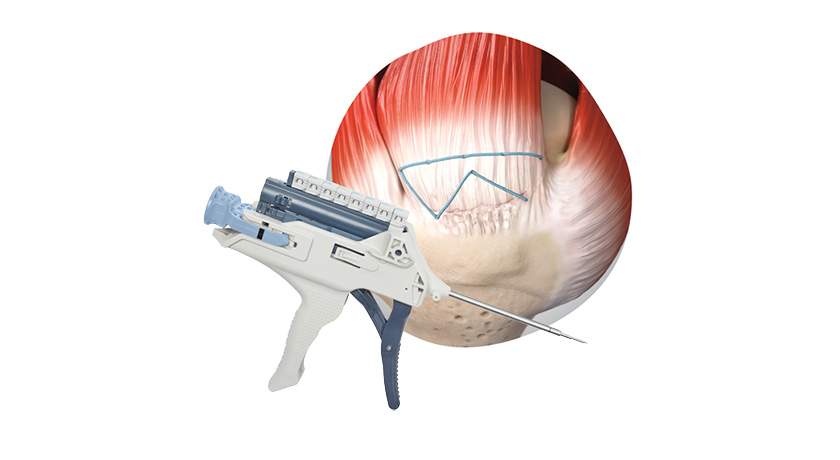
Acquired by Smith+Nephew in early 2026, the TENDON SEAM rotator cuff repair solution is designed to share load across the repaired tendon, offering superior biomechanical strength and performance, which might help protect the repair through the healing period. The construct features multiple tightly spaced 2x10mm anchors connected by a continuous stitch designed to distribute forces across the repaired tendon with a seam of fixation perpendicular to the direction of load.
“Smith+Nephew is committed to advancing rotator cuff repair through technologies that truly improve patient experience and outcomes,” said Ryan Majkrzak, Senior Vice President & General Manager, Global Sports Medicine for Smith+Nephew. “The TENDON SEAM System was designed to offer a better biomechanical construct for surgeons performing rotator cuff surgery and advance the standard of care.”
Source: Smith+Nephew
Smith+Nephew shared results from the first published biomechanical study showing meaningful improvements in rotator cuff repair biomechanics using its TENDON SEAM Rotator Cuff Repair System when compared to traditional techniques (as compared to prior biomechanical cadaveric studies evaluating the TOE repair; versus knotted TOE in biomechanical...
Smith+Nephew shared results from the first published biomechanical study showing meaningful improvements in rotator cuff repair biomechanics using its TENDON SEAM Rotator Cuff Repair System when compared to traditional techniques (as compared to prior biomechanical cadaveric studies evaluating the TOE repair; versus knotted TOE in biomechanical testing).
The study analyzed biomechanical performance utilizing the TENDON SEAM Rotator Cuff Repair System technique for full-thickness supraspinatus tears. The results obtained in testing in human cadavers were compared to previously published data on knotted and knotless transosseous-equivalent (TOE) constructs using similar protocols to assess relative performance, and demonstrated:
- More than twice the strength of knotted and knotless TOE in biomechanical testing (after 30 cycles at 180N).
- Greater than 10 times reduction in gap formation during cyclic loading versus TOE knotted and knotless repair (after 30 cycles at 180N).
- Ability to maintain integrity under loads estimated to be experienced during the healing period (302N, 500 cycles), supporting the TENDON SEAM Construct’s potential to maintain stability during early recovery.
Acquired by Smith+Nephew in early 2026, the TENDON SEAM rotator cuff repair solution is designed to share load across the repaired tendon, offering superior biomechanical strength and performance, which might help protect the repair through the healing period. The construct features multiple tightly spaced 2x10mm anchors connected by a continuous stitch designed to distribute forces across the repaired tendon with a seam of fixation perpendicular to the direction of load.
“Smith+Nephew is committed to advancing rotator cuff repair through technologies that truly improve patient experience and outcomes,” said Ryan Majkrzak, Senior Vice President & General Manager, Global Sports Medicine for Smith+Nephew. “The TENDON SEAM System was designed to offer a better biomechanical construct for surgeons performing rotator cuff surgery and advance the standard of care.”
Source: Smith+Nephew

You’ve reached your limit.
We’re glad you’re finding value in our content — and we’d love for you to keep going.
Subscribe now for unlimited access to orthopedic business intelligence.

JV
Julie Vetalice is ORTHOWORLD's Editorial Assistant. She has covered the orthopedic industry for over 20 years, having joined the company in 1999.