Copy to clipboard

The North American Spine Society Annual Meeting will be held this week, which means a sizable number of company updates and product launches are expected to be announced by well-known players in the space. But what about lesser-known startups?
Technology innovation in spine is expected to come from smaller companies that still have products in development or have just reached the market. NASS is highlighting some of these players in its Spine Venture Village, an incubator-style hub focused on the future-looking technology in spine.
The Venture Village features multiple AI companies seeking to bring efficiency to patient scheduling and monitoring and is sponsored by IntuitiveX, the medtech incubator founded by surgeon, inventor and investor Jeffrey Roh, M.D. Ahead of conversations taking place at NASS, we’re highlighting three exhibiting companies that we’ve connected with at investor conferences in the last year. These companies represent advancements taking place across implants, powered instruments and enabling technology.
Hubly Brings Efficiency and Safety to Bone Drilling
Hubly Surgical received FDA 510(k) clearance in 2025 for its Hubly Auto-Stop Drill to be used in laminectomies and laminotomies for spinal decompression procedures.
The single-use, cordless drill features SMART auto-stop that detects breakthrough of the bone and immediately halts rotation. The proprietary mechanism is combined with mechanical plunge prevention to avoid forward movement of the drill upon this auto-stop and to protect the patient from harm. The drill also offers real-time visual force indication that aids surgeon control.
Standard surgical drills are reusable, costly, and do not stop automatically, while tissue-sparing saws come with a significant learning curve, said Casey Qadir, Hubly Founder and CEO. Hubly’s design elements are intended to enhance safety, speed, and efficiency while streamlining setup and workflow in the O.R.
Hubly launched its cranial application in the first quarter of 2024 and was already in 95 hospitals with more than 7,000 drills sold by the fourth quarter of 2025. It also received an Innovative Technology contract from Vizient. Ms. Qadir said Hubly’s expanding product portfolio will make the company even more attractive to hospital systems.
Spark Spine Seeks to Accelerate Bone Healing
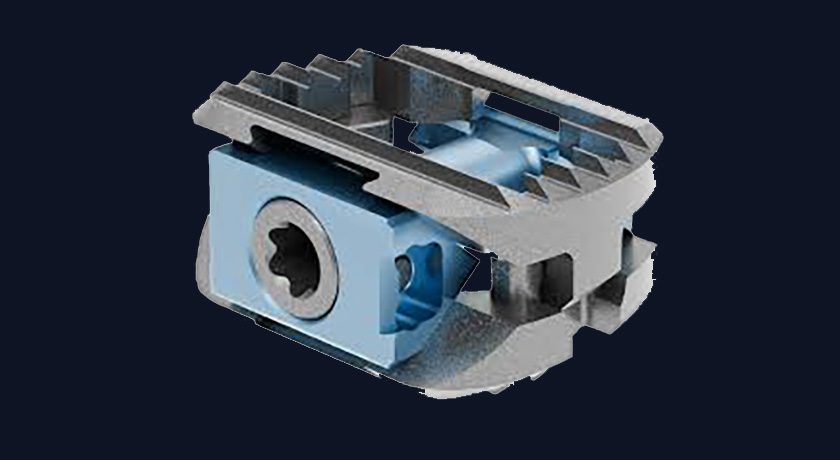
Multiple companies are focused on ways to accelerate patient healing. Spark Spine’s implant is powered by an Electrical Mechanical Polymer (EMP), which harnesses the natural weight and movement of the body to generate electricity. That activity has the potential to accelerate bone growth and improve spinal fusion outcomes.
Spark Spine’s implants use proprietary piezoelectric properties to enhance osteoblast proliferation and promote bone healing by harnessing the bone’s natural response to static polar and dynamic electrical activity.
“Across 30 large animals and two different studies, we’ve seen a greater than 60% improvement in bone apposition at multiple time points,” said Luke Diehl, Vice President of Business Development.
Spark Spine is working on prototypes for multiple product categories in spine, Mr. Diehl said. The EMP technology can fit inside nearly any implant, and the company plans to target multiple orthopedic applications associated with bone and tendon.
The company has submitted its 510(k) application to FDA and expects to receive clearance in the coming months. Spark Spine also announced that its core intellectual property received a Notice of Allowance from the USPTO.
IJX Offers Navigation Expertise
IJX could be classified as a new division rather than a startup. Intellijoint Surgical, a navigation company founded for hip and knee replacement surgery, saw enabling technology gaps in other orthopedic markets and launched IJX as an OEM division.
IJX offers off-the-shelf and custom-designed navigation systems that Intellijoint Surgical believes will be attractive to smaller OEMs looking for a navigation partner. The company’s technology also offers a smaller footprint than competitive technologies, portable optical tracking, and flexible positioning suitable for multiple O.R. layouts, which could make it attractive for the ASC setting.
IJX’s camera is placed within the sterile field and offers a large tracking volume. The primary technology has been used in more than 80,000 surgical cases worldwide. The company notes its expertise also offers the capability of supporting robotic and fluoroscopy-guided surgical workflows and integrating within other systems in development.
When it comes to spine, IJX sees lumbar fusion, sacroiliac joint fusion, and endoscopic and minimally invasive procedures as potential applications for the planning and navigation technology. ATEC Spine, Interventional Systems and Insurgical are among the company’s collaborators
These are just three out of dozens of startup and small companies seeking to advance spine procedures. What companies are you excited to see at NASS this year? We always welcome your feedback.
The North American Spine Society Annual Meeting will be held this week, which means a sizable number of company updates and product launches are expected to be announced by well-known players in the space. But what about lesser-known startups?
Technology innovation in spine is expected to come from smaller companies that still have...
The North American Spine Society Annual Meeting will be held this week, which means a sizable number of company updates and product launches are expected to be announced by well-known players in the space. But what about lesser-known startups?
Technology innovation in spine is expected to come from smaller companies that still have products in development or have just reached the market. NASS is highlighting some of these players in its Spine Venture Village, an incubator-style hub focused on the future-looking technology in spine.
The Venture Village features multiple AI companies seeking to bring efficiency to patient scheduling and monitoring and is sponsored by IntuitiveX, the medtech incubator founded by surgeon, inventor and investor Jeffrey Roh, M.D. Ahead of conversations taking place at NASS, we’re highlighting three exhibiting companies that we’ve connected with at investor conferences in the last year. These companies represent advancements taking place across implants, powered instruments and enabling technology.
Hubly Brings Efficiency and Safety to Bone Drilling
Hubly Surgical received FDA 510(k) clearance in 2025 for its Hubly Auto-Stop Drill to be used in laminectomies and laminotomies for spinal decompression procedures.
The single-use, cordless drill features SMART auto-stop that detects breakthrough of the bone and immediately halts rotation. The proprietary mechanism is combined with mechanical plunge prevention to avoid forward movement of the drill upon this auto-stop and to protect the patient from harm. The drill also offers real-time visual force indication that aids surgeon control.
Standard surgical drills are reusable, costly, and do not stop automatically, while tissue-sparing saws come with a significant learning curve, said Casey Qadir, Hubly Founder and CEO. Hubly’s design elements are intended to enhance safety, speed, and efficiency while streamlining setup and workflow in the O.R.
Hubly launched its cranial application in the first quarter of 2024 and was already in 95 hospitals with more than 7,000 drills sold by the fourth quarter of 2025. It also received an Innovative Technology contract from Vizient. Ms. Qadir said Hubly’s expanding product portfolio will make the company even more attractive to hospital systems.
Spark Spine Seeks to Accelerate Bone Healing
Multiple companies are focused on ways to accelerate patient healing. Spark Spine’s implant is powered by an Electrical Mechanical Polymer (EMP), which harnesses the natural weight and movement of the body to generate electricity. That activity has the potential to accelerate bone growth and improve spinal fusion outcomes.
Spark Spine’s implants use proprietary piezoelectric properties to enhance osteoblast proliferation and promote bone healing by harnessing the bone’s natural response to static polar and dynamic electrical activity.
“Across 30 large animals and two different studies, we’ve seen a greater than 60% improvement in bone apposition at multiple time points,” said Luke Diehl, Vice President of Business Development.
Spark Spine is working on prototypes for multiple product categories in spine, Mr. Diehl said. The EMP technology can fit inside nearly any implant, and the company plans to target multiple orthopedic applications associated with bone and tendon.
The company has submitted its 510(k) application to FDA and expects to receive clearance in the coming months. Spark Spine also announced that its core intellectual property received a Notice of Allowance from the USPTO.
IJX Offers Navigation Expertise
IJX could be classified as a new division rather than a startup. Intellijoint Surgical, a navigation company founded for hip and knee replacement surgery, saw enabling technology gaps in other orthopedic markets and launched IJX as an OEM division.
IJX offers off-the-shelf and custom-designed navigation systems that Intellijoint Surgical believes will be attractive to smaller OEMs looking for a navigation partner. The company’s technology also offers a smaller footprint than competitive technologies, portable optical tracking, and flexible positioning suitable for multiple O.R. layouts, which could make it attractive for the ASC setting.
IJX’s camera is placed within the sterile field and offers a large tracking volume. The primary technology has been used in more than 80,000 surgical cases worldwide. The company notes its expertise also offers the capability of supporting robotic and fluoroscopy-guided surgical workflows and integrating within other systems in development.
When it comes to spine, IJX sees lumbar fusion, sacroiliac joint fusion, and endoscopic and minimally invasive procedures as potential applications for the planning and navigation technology. ATEC Spine, Interventional Systems and Insurgical are among the company’s collaborators
These are just three out of dozens of startup and small companies seeking to advance spine procedures. What companies are you excited to see at NASS this year? We always welcome your feedback.

You’ve reached your limit.
We’re glad you’re finding value in our content — and we’d love for you to keep going.
Subscribe now for unlimited access to orthopedic business intelligence.

CL
Carolyn LaWell is ORTHOWORLD's Chief Content Officer. She joined ORTHOWORLD in 2012 to oversee its editorial and industry education. She previously served in editor roles at B2B magazines and newspapers.