

 Copy to clipboard
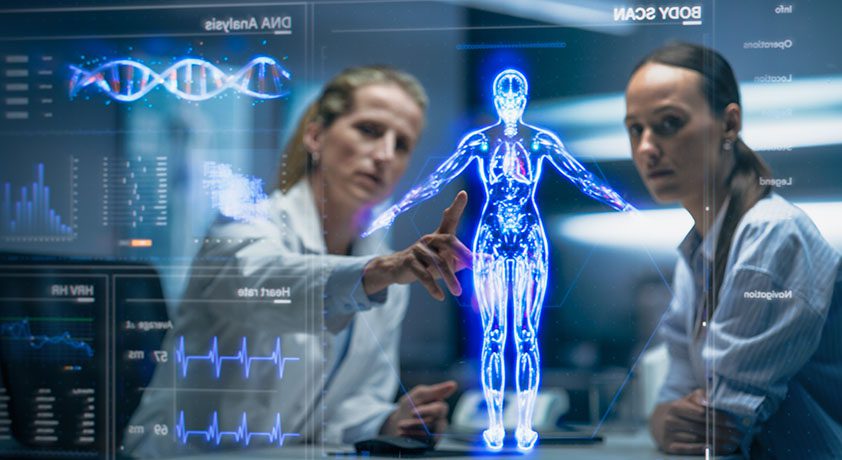
Digital twin technology, which in orthopedics produces virtual, data-rich replicas of a patient’s anatomy, is beginning to reshape how medicine understands and personalizes care. After receiving a significant gift from Lauren and Robert Steers to fund the development of their Digital Twin Platform, Hospital for Special Surgery (HSS) is aiming to transform patient care into highly individualized and even predictive opportunities.
To explore what this transformation looks like in practice, we spoke with Andrew Pearle, M.D., an orthopedic surgeon, Chief Emeritus of the Sports Medicine Institute and Lauren and Robert Steers Chair in Orthopedic Research and Innovation at HSS. Dr. Pearle has used computational modeling to inform ACL procedures and will lead HSS’ expansion of its digital twin program.
Our interview with him has been edited for length and brevity.
How is HSS using digital twin technology today?
Dr. Pearle: We’ve been working on a physics-based computational model of the knee for the past decade. I work in the Department of Biomechanics in addition to my clinical responsibility, and in my lab, we refer to it as a computational model, but now we’re really thinking about a digital twin framework. To create the computational model, we take an MRI of the knee and integrate data from the MRI with AI to develop a 3D model that includes the bone, cartilage, and meniscus. The model becomes a virtual replica of the knee.
You can then stress this digital twin of the knee. For example, you can subject it to a pivot shift loading maneuver and see in a personalized fashion what that knee does when you make the pivot shift. What we’ve discovered is that knees behave quite differently in the pivot shift exam. Simulations of the digital twin even give us insight into patients who might be more susceptible to ACL injury. This type of information can be used to plan surgical procedures.
For example, if somebody’s an ACL high loader, they may be a candidate for an ACL reconstruction with a lateral extra-articular tenodesis. It may also be used as a screening tool to understand who may be at risk for ACL injuries. These are all theoretical, but they give us a hint as to how we might utilize this type of data in the future.
Orthopedics is all about decision-making. Is the patient a candidate for surgery, or physical therapy? This is providing us with much more personalized information on our patients, and potentially even allows us to screen athletes. What we do with this data is something that future generations will have to navigate.
At HSS, we are thinking about the future. You can run very personalized simulations to refine treatment plans further. We view this as a genuine collaboration among imaging, biomechanics, data scientists, engineering, AI, and other disciplines that must come together to realize the dream of having a digital twin care companion that travels with you. The truly fascinating aspect is that the patient may be able to query their digital twin, much like ChatGPT. You ask your digital twin, “Should I run this marathon?” or “What will my knee look like in five years if I continue to play soccer?” That’s the big idea.
How will the recent funding you received enhance the use of digital twins at HSS?
Dr. Pearle: First, I would like to express my gratitude to Lauren and Robert Steers, who have been visionaries and funded several programs at HSS. Now they’ve made this enormous gift to accelerate the clinical implementation of what we see as the first iteration of the digital twin in orthopedics. We will focus on the knee and the clinical implementation of this physics-based computational model within a clinical workflow. We hope that four years from now, every patient who comes to HSS with an appropriate clinical problem will receive a digital twin of their knee.
We’re designing a software platform that will leverage the decade of work we’ve done on a physics-based platform and incorporate additional inputs, such as motion analysis, strength data, demographics, and the sport you play, among others. These are all critical inputs.
The modular platform also includes other joints, such as the shoulder, hip, ankle, and even the spine. We want this to be flexible, almost like the Omniverse is for manufacturing. A platform like that doesn’t exist in healthcare right now. We can create this at HSS because we have engineers, radiology support, clinicians and data scientists all in-house. We also possess the clinical volume and know-how. And now, the funding to make this dream possible.
For what types of use cases are you using digital twins?
Dr. Pearle: The use cases we’re discussing right now are ACL and ligament surgeries, as well as prevention and screening. There are numerous adjuvant ACL procedures in consideration by surgeons. For example, augmentation of ACL procedures with lateral extra-articular tenodesis, as well as slope-leveling osteotomies. The use case of ACL surgery helps us determine which knees are suitable for conservative treatment, versus ACL reconstruction alone, versus ACL reconstruction with augmenting treatments.
We believe that in the future we can plan arthroplasty-type procedures, osteotomies, patellofemoral procedures and cartilage procedures, and run simulations to understand which patients are the best candidates for which procedure.
In terms of patient outcomes, what are some of the major benefits of using digital twins in orthopedics?
Dr. Pearle: This technology can play a big role in prevention and optimizing a patient’s health span. I believe it will be crucial in refining surgical procedures. Patients want to know which sports they should avoid, which ones will overload their knees. We all have an envelope of activity that we should live within, but have no idea what that entails for each of us as individuals. Optimizing a lifestyle for people that maximizes their activity while protecting their joints is an unmet need that this technology can potentially address.
You mentioned briefly that speed is an issue with digital tools right now. Are there other limitations of digital twins today?
Dr. Pearle: Absolutely. We have no idea how to use this information in clinical decision-making. The twin is only as good as the data that goes into it, and that’s a big, big deal in medicine. You have to know how accurate and predictive your model is. Do you trust your models versus clinical intuition? We’re at the nascent stage of this. Integrating digital twin technology into clinical practice will require significant time, research, and thought before it can be effectively implemented.
Digital twin technology, which in orthopedics produces virtual, data-rich replicas of a patient’s anatomy, is beginning to reshape how medicine understands and personalizes care. After receiving a significant gift from Lauren and Robert Steers to fund the development of their Digital Twin Platform, Hospital for Special Surgery (HSS) is aiming...
Digital twin technology, which in orthopedics produces virtual, data-rich replicas of a patient’s anatomy, is beginning to reshape how medicine understands and personalizes care. After receiving a significant gift from Lauren and Robert Steers to fund the development of their Digital Twin Platform, Hospital for Special Surgery (HSS) is aiming to transform patient care into highly individualized and even predictive opportunities.
To explore what this transformation looks like in practice, we spoke with Andrew Pearle, M.D., an orthopedic surgeon, Chief Emeritus of the Sports Medicine Institute and Lauren and Robert Steers Chair in Orthopedic Research and Innovation at HSS. Dr. Pearle has used computational modeling to inform ACL procedures and will lead HSS’ expansion of its digital twin program.
Our interview with him has been edited for length and brevity.
How is HSS using digital twin technology today?
Dr. Pearle: We’ve been working on a physics-based computational model of the knee for the past decade. I work in the Department of Biomechanics in addition to my clinical responsibility, and in my lab, we refer to it as a computational model, but now we’re really thinking about a digital twin framework. To create the computational model, we take an MRI of the knee and integrate data from the MRI with AI to develop a 3D model that includes the bone, cartilage, and meniscus. The model becomes a virtual replica of the knee.
You can then stress this digital twin of the knee. For example, you can subject it to a pivot shift loading maneuver and see in a personalized fashion what that knee does when you make the pivot shift. What we’ve discovered is that knees behave quite differently in the pivot shift exam. Simulations of the digital twin even give us insight into patients who might be more susceptible to ACL injury. This type of information can be used to plan surgical procedures.
For example, if somebody’s an ACL high loader, they may be a candidate for an ACL reconstruction with a lateral extra-articular tenodesis. It may also be used as a screening tool to understand who may be at risk for ACL injuries. These are all theoretical, but they give us a hint as to how we might utilize this type of data in the future.
Orthopedics is all about decision-making. Is the patient a candidate for surgery, or physical therapy? This is providing us with much more personalized information on our patients, and potentially even allows us to screen athletes. What we do with this data is something that future generations will have to navigate.
At HSS, we are thinking about the future. You can run very personalized simulations to refine treatment plans further. We view this as a genuine collaboration among imaging, biomechanics, data scientists, engineering, AI, and other disciplines that must come together to realize the dream of having a digital twin care companion that travels with you. The truly fascinating aspect is that the patient may be able to query their digital twin, much like ChatGPT. You ask your digital twin, “Should I run this marathon?” or “What will my knee look like in five years if I continue to play soccer?” That’s the big idea.
How will the recent funding you received enhance the use of digital twins at HSS?
Dr. Pearle: First, I would like to express my gratitude to Lauren and Robert Steers, who have been visionaries and funded several programs at HSS. Now they’ve made this enormous gift to accelerate the clinical implementation of what we see as the first iteration of the digital twin in orthopedics. We will focus on the knee and the clinical implementation of this physics-based computational model within a clinical workflow. We hope that four years from now, every patient who comes to HSS with an appropriate clinical problem will receive a digital twin of their knee.
We’re designing a software platform that will leverage the decade of work we’ve done on a physics-based platform and incorporate additional inputs, such as motion analysis, strength data, demographics, and the sport you play, among others. These are all critical inputs.
The modular platform also includes other joints, such as the shoulder, hip, ankle, and even the spine. We want this to be flexible, almost like the Omniverse is for manufacturing. A platform like that doesn’t exist in healthcare right now. We can create this at HSS because we have engineers, radiology support, clinicians and data scientists all in-house. We also possess the clinical volume and know-how. And now, the funding to make this dream possible.
For what types of use cases are you using digital twins?
Dr. Pearle: The use cases we’re discussing right now are ACL and ligament surgeries, as well as prevention and screening. There are numerous adjuvant ACL procedures in consideration by surgeons. For example, augmentation of ACL procedures with lateral extra-articular tenodesis, as well as slope-leveling osteotomies. The use case of ACL surgery helps us determine which knees are suitable for conservative treatment, versus ACL reconstruction alone, versus ACL reconstruction with augmenting treatments.
We believe that in the future we can plan arthroplasty-type procedures, osteotomies, patellofemoral procedures and cartilage procedures, and run simulations to understand which patients are the best candidates for which procedure.
In terms of patient outcomes, what are some of the major benefits of using digital twins in orthopedics?
Dr. Pearle: This technology can play a big role in prevention and optimizing a patient’s health span. I believe it will be crucial in refining surgical procedures. Patients want to know which sports they should avoid, which ones will overload their knees. We all have an envelope of activity that we should live within, but have no idea what that entails for each of us as individuals. Optimizing a lifestyle for people that maximizes their activity while protecting their joints is an unmet need that this technology can potentially address.
You mentioned briefly that speed is an issue with digital tools right now. Are there other limitations of digital twins today?
Dr. Pearle: Absolutely. We have no idea how to use this information in clinical decision-making. The twin is only as good as the data that goes into it, and that’s a big, big deal in medicine. You have to know how accurate and predictive your model is. Do you trust your models versus clinical intuition? We’re at the nascent stage of this. Integrating digital twin technology into clinical practice will require significant time, research, and thought before it can be effectively implemented.

You’ve reached your limit.
We’re glad you’re finding value in our content — and we’d love for you to keep going.
Subscribe now for unlimited access to orthopedic business intelligence.

HT
Heather Tunstall is an ORTHOWORLD Contributor and owner of Tunstall Content.