

 Copy to clipboard
According to estimates, around 75% of orthopedic surgeons performing hips and knees still use manual instrumentation. OrthAlign is on a mission to change that with its growing portfolio of small, efficient and cost-effective technologies. The company has racked up more than 450,000 procedures, and its technologies tend to be very sticky among surgeon customers.
We spoke with OrthAlign CEO Eric Timko about the company’s place in the technology market, its newly-cleared Lantern ASC system and the company’s inroads into the European market. Excerpts from our conversation follow, edited for clarity and brevity.
How have you seen the surgeon appetite for technology change over the last five years?
Mr. Timko: Fortunately, we’ve been doing this for quite some time. We’ve got over 450,000 cases of great solid data. Accuracy is our table stakes. As we look at where the market’s going today, I think two things are driving it.
One is the move to the ASC, which we’re all firmly aware of, but the second is the move to technology. I think that surgeons are moving to technology today faster than ever. Part of it is COVID. The other part is the teaching institutions that are just ramming technology down everybody’s throats. The good news for us is we’re in the middle of all that.
Technology still has not gained the traction I think we all expected 15 years ago, right? So, why is that? Two things come into play. It’s got to be a technology for the masses, and it’s got to be efficient.
It has to be open to things that affect your day-to-day workflow, right? Do I need imaging? I use different implants for different procedures; all of these pigeonhole the robots and open the door for us.
Our success today is based on the fact that we are in a good position for the masses. Those who have not adapted technology, or even those who have, may have a robot in their hospital, but they go to an ASC, or they go to several facilities. They can’t take a robot with them, so here we are, traveling with them, almost in their backpack to go do the next cases.
What differentiates Lantern ASC from previous OrthAlign technologies?
Mr. Timko: We have been a single-use company since inception. You bring us into the sterile field and use the device; accelerometers and gyroscopes tell the surgeon where they are, lines great, accurate, all those things.
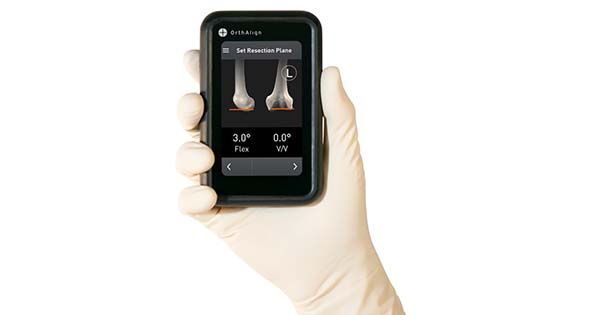
None of that changes with Lantern ASC, except that now we’re in a reusable form factor driven by a smart pack. The smart pack will plug into the back; once it goes into the sterile field, it’s in an Otter Box, essentially. Inside that box it retains the full functionality of the Lantern; it’s just protected in this sterile box.
Our anticipation is that it will be used in 50 procedures versus one. So, thinking about flexibility in regard to pricing, to volume discounts, all of those things come into play. When it comes to performance, it’s exactly the same. You’re going to get Lantern in a reusable form factor, which is what we’re most excited about. Implant agnostic, no imaging required in the sterile field, so the surgeon is driving the system.
All of those things that have built our base of surgeons who have stuck with us and continue to stay with us, now give them some more flexibility. For the ASC environment, we all know two aspects that really matter: one, accuracy is table stakes, but efficiency and cost effectiveness are the two things that we bring to the table now with Lantern ASC that will differentiate us.
We expect surgeons to be time-neutral or better using our technology. Regarding cost effectiveness, you now have a Lantern that can be used 50 times. We can work with you on pricing in the ASC environment. We’re really, really excited about it. The implant agnostic piece of the puzzle is big for us, because some facilities will have six different surgeons with six different implant companies, and we can put them all in.
OrthAlign is now moving into Europe after obtaining approval under the CE Mark. What are some unique market dynamics there for technology?
Mr. Timko: The European market is strong on technology and outcomes-based modeling. We fit very nicely, right? We’re not a new technology that’s performed 2,000 or 5,000 cases coming in. We’ve got 450,000 cases of data that we can lay in front of them that resonates so that when they move to a technology, it’s got to be price competitive, and it’s got to fit in their workflow. We do all that now, but it’s the accuracy piece of this puzzle that is truly powerful.
Further, looking at the implant players in international markets, especially the CE Mark-based countries, it’s not just the big four or five. There are multiple implant companies, and we can put in multiple implants. We fit nicely across several different cross-functional areas that will resonate with different countries and different implant players. We’re talking to them all and are excited about the feedback.
The interest has been fantastic. We’re working through the kinks and contracts to get it going, and we expect sometime in July to start to see some action and some penetration.
According to estimates, around 75% of orthopedic surgeons performing hips and knees still use manual instrumentation. OrthAlign is on a mission to change that with its growing portfolio of small, efficient and cost-effective technologies. The company has racked up more than 450,000 procedures, and its technologies tend to be very sticky among...
According to estimates, around 75% of orthopedic surgeons performing hips and knees still use manual instrumentation. OrthAlign is on a mission to change that with its growing portfolio of small, efficient and cost-effective technologies. The company has racked up more than 450,000 procedures, and its technologies tend to be very sticky among surgeon customers.
We spoke with OrthAlign CEO Eric Timko about the company’s place in the technology market, its newly-cleared Lantern ASC system and the company’s inroads into the European market. Excerpts from our conversation follow, edited for clarity and brevity.
How have you seen the surgeon appetite for technology change over the last five years?
Mr. Timko: Fortunately, we’ve been doing this for quite some time. We’ve got over 450,000 cases of great solid data. Accuracy is our table stakes. As we look at where the market’s going today, I think two things are driving it.
One is the move to the ASC, which we’re all firmly aware of, but the second is the move to technology. I think that surgeons are moving to technology today faster than ever. Part of it is COVID. The other part is the teaching institutions that are just ramming technology down everybody’s throats. The good news for us is we’re in the middle of all that.
Technology still has not gained the traction I think we all expected 15 years ago, right? So, why is that? Two things come into play. It’s got to be a technology for the masses, and it’s got to be efficient.
It has to be open to things that affect your day-to-day workflow, right? Do I need imaging? I use different implants for different procedures; all of these pigeonhole the robots and open the door for us.
Our success today is based on the fact that we are in a good position for the masses. Those who have not adapted technology, or even those who have, may have a robot in their hospital, but they go to an ASC, or they go to several facilities. They can’t take a robot with them, so here we are, traveling with them, almost in their backpack to go do the next cases.
What differentiates Lantern ASC from previous OrthAlign technologies?
Mr. Timko: We have been a single-use company since inception. You bring us into the sterile field and use the device; accelerometers and gyroscopes tell the surgeon where they are, lines great, accurate, all those things.
None of that changes with Lantern ASC, except that now we’re in a reusable form factor driven by a smart pack. The smart pack will plug into the back; once it goes into the sterile field, it’s in an Otter Box, essentially. Inside that box it retains the full functionality of the Lantern; it’s just protected in this sterile box.
Our anticipation is that it will be used in 50 procedures versus one. So, thinking about flexibility in regard to pricing, to volume discounts, all of those things come into play. When it comes to performance, it’s exactly the same. You’re going to get Lantern in a reusable form factor, which is what we’re most excited about. Implant agnostic, no imaging required in the sterile field, so the surgeon is driving the system.
All of those things that have built our base of surgeons who have stuck with us and continue to stay with us, now give them some more flexibility. For the ASC environment, we all know two aspects that really matter: one, accuracy is table stakes, but efficiency and cost effectiveness are the two things that we bring to the table now with Lantern ASC that will differentiate us.
We expect surgeons to be time-neutral or better using our technology. Regarding cost effectiveness, you now have a Lantern that can be used 50 times. We can work with you on pricing in the ASC environment. We’re really, really excited about it. The implant agnostic piece of the puzzle is big for us, because some facilities will have six different surgeons with six different implant companies, and we can put them all in.
OrthAlign is now moving into Europe after obtaining approval under the CE Mark. What are some unique market dynamics there for technology?
Mr. Timko: The European market is strong on technology and outcomes-based modeling. We fit very nicely, right? We’re not a new technology that’s performed 2,000 or 5,000 cases coming in. We’ve got 450,000 cases of data that we can lay in front of them that resonates so that when they move to a technology, it’s got to be price competitive, and it’s got to fit in their workflow. We do all that now, but it’s the accuracy piece of this puzzle that is truly powerful.
Further, looking at the implant players in international markets, especially the CE Mark-based countries, it’s not just the big four or five. There are multiple implant companies, and we can put in multiple implants. We fit nicely across several different cross-functional areas that will resonate with different countries and different implant players. We’re talking to them all and are excited about the feedback.
The interest has been fantastic. We’re working through the kinks and contracts to get it going, and we expect sometime in July to start to see some action and some penetration.

You’ve reached your limit.
We’re glad you’re finding value in our content — and we’d love for you to keep going.
Subscribe now for unlimited access to orthopedic business intelligence.

ME
Mike Evers is a Senior Market Analyst and writer with over 15 years of experience in the medical industry, spanning cardiac rhythm management, ER coding and billing, and orthopedics. He joined ORTHOWORLD in 2018, where he provides market analysis and editorial coverage.