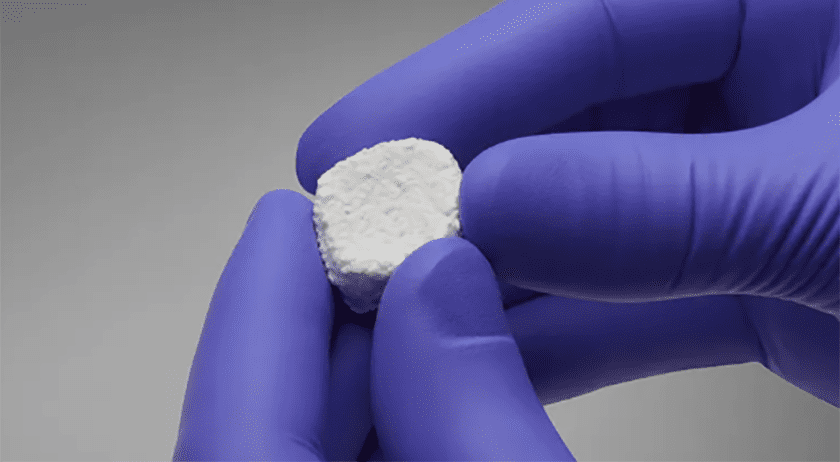
OssDsign announced the publication of a new scientific article in The Journal of Bone and Mineral Research. The preclinical study evaluated OssDsign Catalyst as a standalone bone graft in trauma, comparing it to an earlier-generation bone graft. The results show significantly more bone formation with OssDsign Catalyst at earlier timepoints, as well as clear evidence that the graft is naturally broken down and replaced by the body over time.
In the study, researchers compared the bone-healing response of two synthetic bone graft materials – one with a nanoscale structure (OssDsign Catalyst) and one with a micron-sized structure typical of earlier-generation grafts. The materials were implanted into critical-sized bone defects in the knee joints of rabbits and evaluated at 4, 8, 12 and 26 weeks.
OssDsign Catalyst achieved full healing of the defect at the earliest timepoint of 4 weeks, as opposed to the earlier-generation graft which took twice as long. OssDsign Catalyst also showed continuous, progressive biological resorption and replacement with host bone throughout the study, with graft material decreasing by 60% over 26 weeks. In contrast, the earlier-generation graft showed minimal remodeling, remaining largely unchanged from week four onwards.
Importantly, the coupled remodeling of OssDsign Catalyst was not only visible in histology but supported by statistically significant quantitative data — providing strong scientific evidence for one of the key advantages of fourth-generation synthetic bone grafts.
OssDsign announced the publication of a new scientific article in The Journal of Bone and Mineral Research. The preclinical study evaluated OssDsign Catalyst as a standalone bone graft in trauma, comparing it to an earlier-generation bone graft. The results show significantly more bone formation with OssDsign Catalyst at earlier timepoints, as...
OssDsign announced the publication of a new scientific article in The Journal of Bone and Mineral Research. The preclinical study evaluated OssDsign Catalyst as a standalone bone graft in trauma, comparing it to an earlier-generation bone graft. The results show significantly more bone formation with OssDsign Catalyst at earlier timepoints, as well as clear evidence that the graft is naturally broken down and replaced by the body over time.
In the study, researchers compared the bone-healing response of two synthetic bone graft materials – one with a nanoscale structure (OssDsign Catalyst) and one with a micron-sized structure typical of earlier-generation grafts. The materials were implanted into critical-sized bone defects in the knee joints of rabbits and evaluated at 4, 8, 12 and 26 weeks.
OssDsign Catalyst achieved full healing of the defect at the earliest timepoint of 4 weeks, as opposed to the earlier-generation graft which took twice as long. OssDsign Catalyst also showed continuous, progressive biological resorption and replacement with host bone throughout the study, with graft material decreasing by 60% over 26 weeks. In contrast, the earlier-generation graft showed minimal remodeling, remaining largely unchanged from week four onwards.
Importantly, the coupled remodeling of OssDsign Catalyst was not only visible in histology but supported by statistically significant quantitative data — providing strong scientific evidence for one of the key advantages of fourth-generation synthetic bone grafts.




 Copy to clipboard