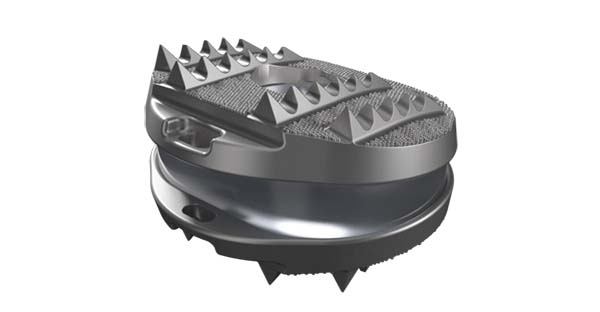
A new peer-reviewed biomechanical study has been published demonstrating that the AxioMed Viscoelastic Total Disc Replacement (VTDR) is the first spinal disc replacement shown to reproduce key stiffness characteristics and natural-like motion behaviors of a healthy human lumbar disc.
The study, titled “ASTM biomechanical study comparing the AxioMed lumbar viscoelastic disc to human lumbar disc data,” shows that AxioMed’s VTDR reproduces native lumbar-disc biomechanics across axial compression, flexion-extension, and shear — a level of similarity not previously demonstrated in published artificial disc research, according to the company.
For over 40 years, surgeons and engineers have attempted to create a disc replacement that behaves like a natural disc. Traditional ball-and-socket implants create motion, but not natural biomechanics — often leading to abnormal forces, adjacent-segment disease, and limited long-term success. Researchers concluded that the AxioMed VTDR “reproduces lumbar disc stiffness more closely than prior designs.”
“This study confirms what our team has been working toward for nearly two decades — a spinal disc replacement that does not just move, but truly behaves like the native human disc,” said Dr. Kingsley R. Chin, a spinal surgeon who authored the study and serves as CEO of KIC Ventures. This breakthrough represents a new era where fusion is no longer the default solution and patients can regain natural, healthy motion.”
A new peer-reviewed biomechanical study has been published demonstrating that the AxioMed Viscoelastic Total Disc Replacement (VTDR) is the first spinal disc replacement shown to reproduce key stiffness characteristics and natural-like motion behaviors of a healthy human lumbar disc.
The study, titled "ASTM biomechanical study comparing the...
A new peer-reviewed biomechanical study has been published demonstrating that the AxioMed Viscoelastic Total Disc Replacement (VTDR) is the first spinal disc replacement shown to reproduce key stiffness characteristics and natural-like motion behaviors of a healthy human lumbar disc.
The study, titled “ASTM biomechanical study comparing the AxioMed lumbar viscoelastic disc to human lumbar disc data,” shows that AxioMed’s VTDR reproduces native lumbar-disc biomechanics across axial compression, flexion-extension, and shear — a level of similarity not previously demonstrated in published artificial disc research, according to the company.
For over 40 years, surgeons and engineers have attempted to create a disc replacement that behaves like a natural disc. Traditional ball-and-socket implants create motion, but not natural biomechanics — often leading to abnormal forces, adjacent-segment disease, and limited long-term success. Researchers concluded that the AxioMed VTDR “reproduces lumbar disc stiffness more closely than prior designs.”
“This study confirms what our team has been working toward for nearly two decades — a spinal disc replacement that does not just move, but truly behaves like the native human disc,” said Dr. Kingsley R. Chin, a spinal surgeon who authored the study and serves as CEO of KIC Ventures. This breakthrough represents a new era where fusion is no longer the default solution and patients can regain natural, healthy motion.”




 Copy to clipboard