

 Copy to clipboard

Orthopedic enabling technology continued to attract significant strategic investment in 3Q26, spanning surgical robots, navigation, planning, AI and digital healthcare tools. Acquisitions, partnerships and product launches point to the industry’s broader push to offer surgeons technology that makes surgeries more precise and patient care more personalized.
Here’s a look at the enabling technology activity that could shape the future of joint replacement and spine surgery.
Robotic and Surgical Intelligence Acquisitions
Enovis entered a binding offer to acquire eCential Robotics for an upfront enterprise value of ~USD $180 million. The transaction is expected to close during 4Q26 and provide Enovis with a more complete enabling technology ecosystem.
eCential Robotics’ Op.n platform combines surgical navigation and active robotics into a single system. The acquisition will add robotic capabilities to the Enovis ASTRA platform, which already includes ASTRA Arvis wearable tech for precision spatial navigation and the ASTRA Portal that employs AI for case planning with automatic segmentation and landmarking.
eCential Robotics’ expertise in robotics engineering, software development, and surgical automation complements Enovis’ existing technology portfolio while adding capabilities that accelerate its innovation roadmap.
Globus Medical acquired Higgs Boson Health, a digital healthcare experience company. Higgs Boson Health’s technology and team will become part of Globus Medical’s surgical intelligence ecosystem, which connects patient engagement, outcomes data, and analytics across the care journey.
Higgs Boson Health has built a digital platform that guides patients through surgical paths and recovery while giving care teams real-time visibility between visits. The company’s software developers and AI scientists will join Globus to expand its portfolio of digital tools used by patients, caregivers and providers.
Globus Medical Founder and Executive Chairman David Paul said the ultimate goal is to achieve 95% good outcomes at 10 years for all musculoskeletal surgeries.
Suzhou MicroPort and Tinavi Medical Technologies entered into a letter of intent regarding Tinavi’s potential acquisition of a controlling interest in Shanghai MicroPort Orthopedics.
Shanghai MicroPort Orthopedics serves global joint replacement markets, while Tinavi has a leading position in orthopedic surgical robots. The business synergies, strategies, and long-term goals of both parties are highly aligned.
The potential transaction is in the planning stage and is subject to the successful conclusion of commercial negotiations on terms between the parties, the completion of due diligence, internal and regulatory approvals.
Strategic Technology Collaborations
Demetra announced a strategic collaboration with Masmec Biomed, a developer of advanced surgical navigation systems for spine and trauma, AI, and high-complexity medical technologies.
Demetra’s leadership said the collaboration expands the company’s focus beyond implants and biologics into enabling technologies, combining its orthopedic, spine and neuro expertise with Masmec’s capabilities in surgical navigation, AI and biomedical engineering.
In recent years, Demetra has strengthened its position in the orthopedic industry through numerous acquisitions, developed a comprehensive portfolio, and expanded its international footprint.
New Enabling Technology Platforms
Kinomatic launched Kinect, a unified platform that connects surgical planning, case management, and surgeon collaboration for knee and hip joint replacement. The launch builds on the company’s knowledge in preoperative planning and concierge recovery services and advances its investment in AI-native surgical planning.
By capturing a complete, structured record of each patient’s end-to-end surgical experience in one place, Kinect creates the data foundation needed to train and deploy AI models that aid biomedical engineers leading the surgical planning process. Kinect is already being used to train AI models to perform segmentation, and the same connected data is expected to power AI models that help surgeons identify best practices more quickly and assist them directly during planning.
Kinect centralizes all case data, including CT scans, segmentation, and planning files, into a structured data lake that can power the AI surgical planning platform. That same data foundation can extend personalization past the operating room, giving care teams the context to tailor recovery guidance to each patient’s procedure and progress. The platform also manages imaging facilities, surgical configurations, and the implant library directly in system settings. QA review is automated against each plan’s configuration, as well, including a second engineer’s independent peer review, to reduce manual tracking and review steps.
Kinomatic also announced a partnership with WHOOP for its RESTORE pilot, combining continuous biometric monitoring, dedicated patient navigators, evidence-based protocols, and AI-powered care coordination to support patients throughout recovery after joint replacement.
Smith+Nephew and Imperial College London launched a five-year partnership to deliver breakthrough research and innovation for robotic surgery for musculoskeletal conditions, with a focus on computer vision and sensing.
Research topics include markerless registration and tracking, which removes the pins and rigid markers that current systems bolt to bone, meaning fewer incisions and less hardware for the patient, and better consistency for the surgeon. Another topic is computer vision that reads and adapts to a patient’s anatomy in real time.
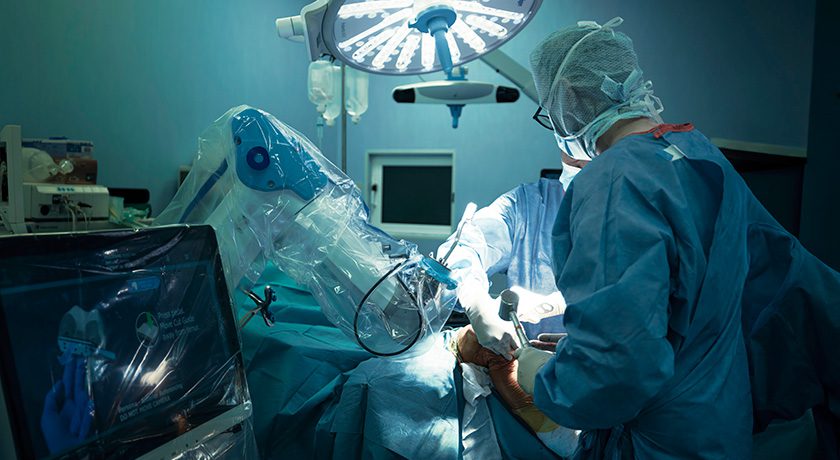
Stryker commenced the full U.S. commercial launch of Mako RPS (Robotic Power System) for total knee replacement, further expanding the Mako portfolio into a new category of orthopedic robotics. Limited release commenced in February 2026.
Compatible with Stryker’s Triathlon Total Knee, Mako RPS for Total Knee features intraoperative planning and a robotically enabled saw equipped with Stryker’s patented active adjustment technology, which responds to a surgeon’s hand movements and helps maintain alignment with the surgical plan in real time. The system provides a familiar cutting experience without the need for cutting blocks and works with Stryker’s multi-specialty Q Guidance System.
Orthopedic enabling technology continued to attract significant strategic investment in 3Q26, spanning surgical robots, navigation, planning, AI and digital healthcare tools. Acquisitions, partnerships and product launches point to the industry’s broader push to offer surgeons technology that makes surgeries more precise and patient care more...
Orthopedic enabling technology continued to attract significant strategic investment in 3Q26, spanning surgical robots, navigation, planning, AI and digital healthcare tools. Acquisitions, partnerships and product launches point to the industry’s broader push to offer surgeons technology that makes surgeries more precise and patient care more personalized.
Here’s a look at the enabling technology activity that could shape the future of joint replacement and spine surgery.
Robotic and Surgical Intelligence Acquisitions
Enovis entered a binding offer to acquire eCential Robotics for an upfront enterprise value of ~USD $180 million. The transaction is expected to close during 4Q26 and provide Enovis with a more complete enabling technology ecosystem.
eCential Robotics’ Op.n platform combines surgical navigation and active robotics into a single system. The acquisition will add robotic capabilities to the Enovis ASTRA platform, which already includes ASTRA Arvis wearable tech for precision spatial navigation and the ASTRA Portal that employs AI for case planning with automatic segmentation and landmarking.
eCential Robotics’ expertise in robotics engineering, software development, and surgical automation complements Enovis’ existing technology portfolio while adding capabilities that accelerate its innovation roadmap.
Globus Medical acquired Higgs Boson Health, a digital healthcare experience company. Higgs Boson Health’s technology and team will become part of Globus Medical’s surgical intelligence ecosystem, which connects patient engagement, outcomes data, and analytics across the care journey.
Higgs Boson Health has built a digital platform that guides patients through surgical paths and recovery while giving care teams real-time visibility between visits. The company’s software developers and AI scientists will join Globus to expand its portfolio of digital tools used by patients, caregivers and providers.
Globus Medical Founder and Executive Chairman David Paul said the ultimate goal is to achieve 95% good outcomes at 10 years for all musculoskeletal surgeries.
Suzhou MicroPort and Tinavi Medical Technologies entered into a letter of intent regarding Tinavi’s potential acquisition of a controlling interest in Shanghai MicroPort Orthopedics.
Shanghai MicroPort Orthopedics serves global joint replacement markets, while Tinavi has a leading position in orthopedic surgical robots. The business synergies, strategies, and long-term goals of both parties are highly aligned.
The potential transaction is in the planning stage and is subject to the successful conclusion of commercial negotiations on terms between the parties, the completion of due diligence, internal and regulatory approvals.
Strategic Technology Collaborations
Demetra announced a strategic collaboration with Masmec Biomed, a developer of advanced surgical navigation systems for spine and trauma, AI, and high-complexity medical technologies.
Demetra’s leadership said the collaboration expands the company’s focus beyond implants and biologics into enabling technologies, combining its orthopedic, spine and neuro expertise with Masmec’s capabilities in surgical navigation, AI and biomedical engineering.
In recent years, Demetra has strengthened its position in the orthopedic industry through numerous acquisitions, developed a comprehensive portfolio, and expanded its international footprint.
New Enabling Technology Platforms
Kinomatic launched Kinect, a unified platform that connects surgical planning, case management, and surgeon collaboration for knee and hip joint replacement. The launch builds on the company’s knowledge in preoperative planning and concierge recovery services and advances its investment in AI-native surgical planning.
By capturing a complete, structured record of each patient’s end-to-end surgical experience in one place, Kinect creates the data foundation needed to train and deploy AI models that aid biomedical engineers leading the surgical planning process. Kinect is already being used to train AI models to perform segmentation, and the same connected data is expected to power AI models that help surgeons identify best practices more quickly and assist them directly during planning.
Kinect centralizes all case data, including CT scans, segmentation, and planning files, into a structured data lake that can power the AI surgical planning platform. That same data foundation can extend personalization past the operating room, giving care teams the context to tailor recovery guidance to each patient’s procedure and progress. The platform also manages imaging facilities, surgical configurations, and the implant library directly in system settings. QA review is automated against each plan’s configuration, as well, including a second engineer’s independent peer review, to reduce manual tracking and review steps.
Kinomatic also announced a partnership with WHOOP for its RESTORE pilot, combining continuous biometric monitoring, dedicated patient navigators, evidence-based protocols, and AI-powered care coordination to support patients throughout recovery after joint replacement.
Smith+Nephew and Imperial College London launched a five-year partnership to deliver breakthrough research and innovation for robotic surgery for musculoskeletal conditions, with a focus on computer vision and sensing.
Research topics include markerless registration and tracking, which removes the pins and rigid markers that current systems bolt to bone, meaning fewer incisions and less hardware for the patient, and better consistency for the surgeon. Another topic is computer vision that reads and adapts to a patient’s anatomy in real time.
Stryker commenced the full U.S. commercial launch of Mako RPS (Robotic Power System) for total knee replacement, further expanding the Mako portfolio into a new category of orthopedic robotics. Limited release commenced in February 2026.
Compatible with Stryker’s Triathlon Total Knee, Mako RPS for Total Knee features intraoperative planning and a robotically enabled saw equipped with Stryker’s patented active adjustment technology, which responds to a surgeon’s hand movements and helps maintain alignment with the surgical plan in real time. The system provides a familiar cutting experience without the need for cutting blocks and works with Stryker’s multi-specialty Q Guidance System.

You’ve reached your limit.
We’re glad you’re finding value in our content — and we’d love for you to keep going.
Subscribe now for unlimited access to orthopedic business intelligence.

JV
Julie Vetalice is ORTHOWORLD's Editorial Assistant. She has covered the orthopedic industry for over 20 years, having joined the company in 1999.